Present at the meeting were members of the Supervision Team: Le Thanh Nam, Hanoi Party Committee member and Chief of Staff of the Hanoi People's Committee, who is also Deputy Head of the team; Do Tam Dieu Quynh, Deputy Head of the Hanoi Party Committee's Inspection Committee; Dinh Manh Hung, Deputy Director of the Department of Home Affairs; Nguyen Thuy Hang, Deputy Chief Inspector of Hanoi; and representatives of relevant departments and agencies under Decision No. 332-QD/TU dated November 30 2025.
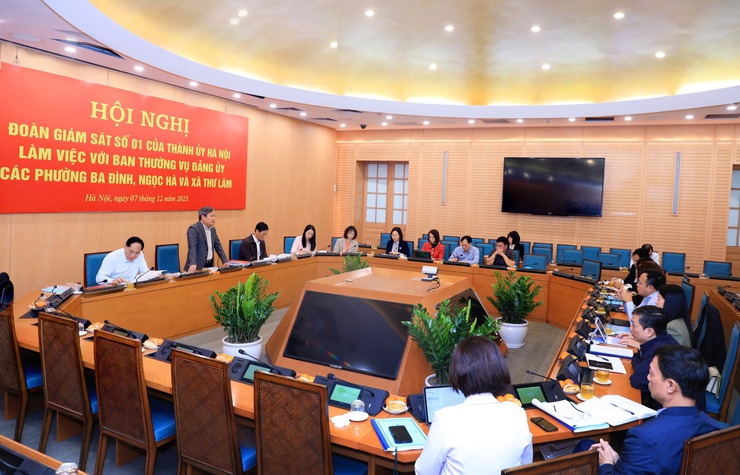
Overview of the meeting.
Reporting at the meeting, Pham Quang Thanh, Secretary of the Ward Party Committee and Chairman of the Ward People's Council, said that immediately after the two-tier local government model began operating on July 1 2025, the Ward Party Committee's Standing Board early moved to renew leadership methods, stay close to reality and uphold the principle of democratic centralism while emphasizing the responsibility of leaders together with collective responsibility.
Working regulations were reviewed and supplemented and the work program was detailed by month and quarter to clearly set priorities and breakthrough tasks during the transitional period of the apparatus.
Concurrently, the ward stepped up publicity and thorough dissemination of central and city regulations on organizing and operating the two-tier model. Ten task forces led directly by Standing Board members and the Standing Board were established to monitor local developments and promptly resolve arising problems so the apparatus would operate smoothly.
As the country's political and administrative center, Ba Dinh Ward identified tightening discipline and administrative order as core tasks, renewing party cell activities, strengthening inspection and supervision of public duties, and standardizing year-end appraisal and review processes toward self-reflection and correction with practical results as the measure.
In implementing key topics, especially digital transformation, administrative reform and urban order management, the Standing Board issued regulations, set up steering committees and assigned clear responsibilities. Two breakthrough priorities were the application of technology in governance and urban renovation and reconstruction tied to building a model ward for discipline and civility.
As a result, in 2025 the ward's political system fulfilled and exceeded many socio-economic targets, national defense and security were maintained, digital transformation and administrative reform advanced significantly, urban landscape became brighter greener cleaner and more beautiful, and efforts to prevent corruption and save public resources were strengthened.
For 2026, Ba Dinh Ward set the goal of further refining the two-tier model toward a leaner more effective apparatus, using appraisal and personnel review as key tools to tighten discipline, while accelerating digital transformation and improving public service quality to underpin the First Congress Resolution of the Ward Party Committee.
At the meeting, members of the Supervision Team exchanged many views to help the Standing Board promptly address difficulties and remove obstacles, and to overcome shortcomings to excellently complete assigned tasks such as arranging public service points, upgrading technical infrastructure and sanitation, clarifying authority between units, accelerating land clearance, organizing major political and cultural events, and overseeing decorations and public displays.
Concluding the meeting, Vu Dai Thang, Chairman of the Hanoi People's Committee and head of Supervision Team No. 01, praised Ba Dinh Ward for its serious responsible and hardworking approach during the initial operation of the two-tier local government model.
He noted this is a critical moment as the municipal Party Committee and the Hanoi People's Council have set a growth target of 11 percent for 2026, which requires coordinated effort across the political system and decisive initiative and creativity at the grassroots level to realize development tasks.
Thang said today's supervision has practical value in identifying difficulties in decentralization delegation and in organizing the new model's operations, and he urged localities to be flexible and not wait for central guidance.
On organizational matters he emphasized that splitting departments and offices must comply with current regulations and that while mechanisms are finalized, the ward should proactively form internal task groups within departments to handle specialized duties and avoid passivity in implementation.
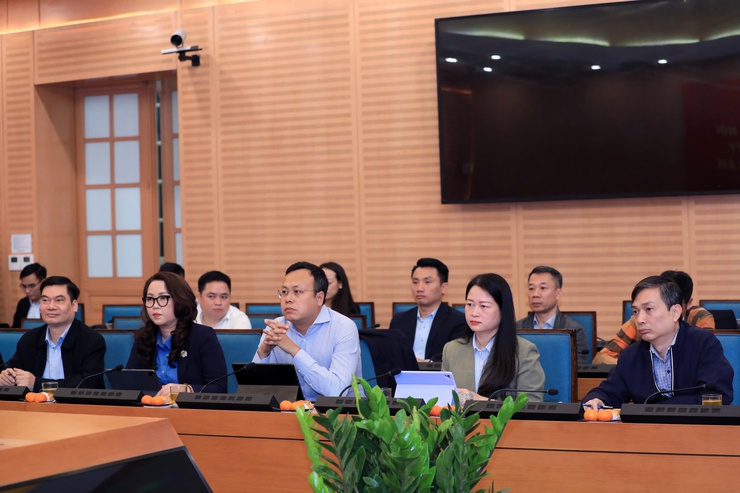
Delegates at the meeting.
Recognizing Ba Dinh Ward's special role as the nation's political and administrative center, the Chairman acknowledged the large volume of duties the ward must carry, from land clearance and major political events to tasks delegated by the city.
On public service, he praised improvements in satisfaction indices and a reduction in negative service feedback as evidence the new governance model and accountable leadership are working, and he said this will be an important basis for the 2025 year-end reviews.
He requested the ward to adhere to the spirit of being proactive creative and not waiting, especially in urgent topics such as digital transformation urban order and administrative reform, and to review responsibilities of each collective and individual in year-end evaluations.
The city will consider the ward's proposals within its authority and encourage wards and communes to proactively propose public space projects parking facilities charging stations and technical standards for premises linked with public investment plans.
Expressing satisfaction with the Standing Board's achievements, the head of Supervision Team No. 01 asked Ba Dinh Ward to maintain unity and consensus and to continue maximizing the effectiveness of the two-tier local government model while completing key thematic tasks tied to the 2025 year-end review.