More than 200 youth delegates attending in person, representing nearly three million young people across Hanoi, exchanged views and proposals across five core areas.
The discussions focused on building a healthy education environment for children and youth, developing young people as digital citizens, the role of youth in science and technology, innovation and digital transformation, youth-led economic development, and international integration and exchange.
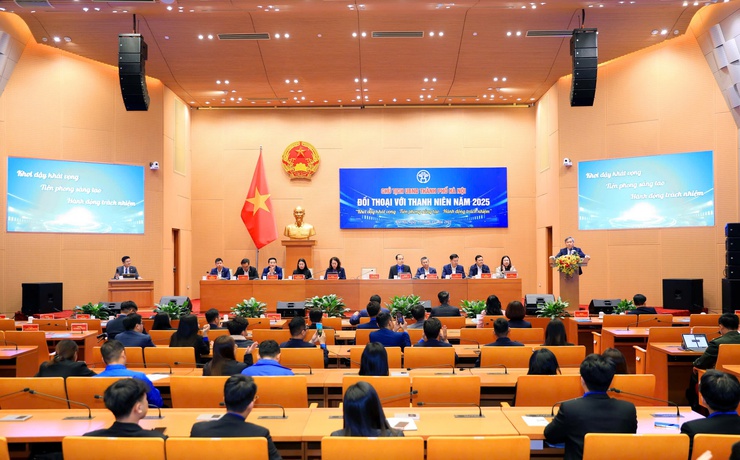
Overview of the event.
Nguyen Kim Hoai Nam, a teacher and head of youth activities at Thanh Cong Secondary School, said the city's education environment is facing two major challenges, including the rapid spread of harmful and false information online and rising school violence, particularly cyberbullying.
“To build a safe and healthy education ecosystem for children and youth in the digital era, what interagency coordination mechanisms will the city put in place to strengthen moral education and digital safety skills?” she asked. “How will these efforts effectively prevent and address school violence?”
Nguyen Phuong Ngoc, Youth Union Secretary at Nguyen Binh Khiem Secondary and High School in Cau Giay Ward, noted that distorted cultural content is widespread on social media. She said content from celebrities and influencers is reaching young people daily and negatively affecting values and character development, and asked what measures the city will take to curb this trend.
Nguyen Thi Viet Linh, Deputy Secretary of the Youth Union at Vietnam National University, said the city has promoted relocating universities and colleges to suburban areas as a long-term solution. She asked about the upcoming roadmap and the city's plans to ensure stable living and learning conditions for students after relocation.
At the conference, Deputy Secretary of the Hanoi Party Committee and Chairman of the Hanoi People’s Committee Vu Dai Thang, along with leaders of city departments, listened directly to proposals from young delegates and responded to their concerns.
City leaders also assigned tasks to relevant agencies to remove obstacles and create favorable conditions for young people to develop their talents and contribute to building a cultured, civilized, and modern capital.
Regarding efforts to build a safe and healthy school environment, Pham Quoc Toan, Deputy Director of the Hanoi Department of Education and Training, said the goal aligns with both national and municipal policy priorities.
He noted that Hanoi hosted the signing of the Hanoi Convention on Cybersecurity and has recently been recognized by UNESCO as a Global Learning City.
"This recognition affirms the capital's standing while placing urgent demands on developing a generation of digital citizens with political awareness, digital competence, ethical values, and social responsibility," he said.
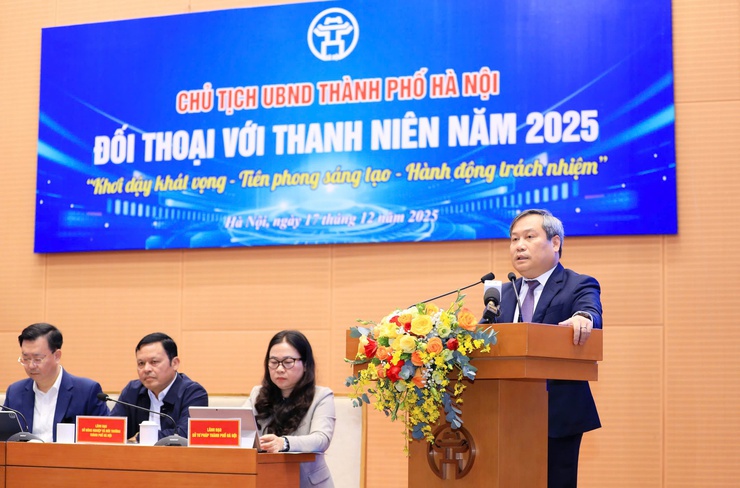
Chairman of the Hanoi People's Committee Vu Dai Thang at the meeting.
In response to current challenges, especially the need for a safe, humane, and healthy education ecosystem for students, the city's education sector has advised Hanoi to focus on several priority directions. These priority areas include building coordination regulations that clearly define responsibilities for life skills education, digital skills training, child protection online, and the handling of school and cyber violence cases.
The Department of Education and Training has also signed coordination regulations with the city police to ensure security and order at educational institutions. Moral education, lifestyle guidance, and safe digital skills training for students have been further strengthened.
On the relocation of universities and colleges to suburban areas, Hanoi Department of Construction Director Nguyen Phi Thuong said the city is developing under a multi-center urban model with new growth poles. Hoa Lac Urban Area has been designated as a science and technology and education hub where universities and colleges will be relocated to form a new development center.
He said the nucleus of this area is Hoa Lac Hi-Tech Park, where Vietnam National University has already relocated part of its operations. Many other universities are preparing plans and projects in line with the approved roadmap.
The City People's Council has adopted a resolution requiring the development of plans to relocate higher education institutions to suburban areas, with priority given to large public universities. By 2030, Hanoi aims to establish university cities such as Hoa Lac and surrounding satellite areas supported by integrated infrastructure.
On connectivity, the city is expected to officially break ground on Metro Line No. 5 linking Van Cao and Hoa Lac on December 19, with an investment capital of about VND74 trillion ($3.0 billion). The line is scheduled to be completed and put into operation before 2030 and will serve as a backbone transport corridor for the comprehensive development of the Hoa Lac area and nearby zones.
Thuong said public universities with large student populations will be concentrated in satellite urban areas, while some inner-city campuses will be retained for postgraduate training, scientific research, and international cooperation. The relocation will be linked with urban renewal, expanded public spaces, and new parks, improving living quality while easing pressure on the inner city.
During the 2025–2030 period, Hanoi aims to relocate major public training institutions, targeting around 200,000 students studying in new university cities. The plan also includes forming training, research, and innovation centers associated with Hoa Lac Hi-Tech Park.
On cultural distortions in online spaces, Hanoi Department of Culture and Sports Director Bach Lien Huong said the city manages around 500 to 600 websites and online platforms operating locally. In 2025, the department coordinated with central and city agencies to address hundreds of violations on social media, with many posts and videos removed for breaching regulations.
She said the city remains firm in strictly handling violations of cultural norms and public conduct. Several artists have been fined at the highest level for inappropriate behavior or statements during performances in Hanoi, including bans on performing in the city.
"The culture sector will continue to work closely with the education sector to build cultural and creative spaces in schools, helping each education institution become a healthy cultural environment that matches Hanoi's role as a Creative City and a Global Learning City," she said.