The conference was chaired by Nguyen Duy Ngoc, a Politburo member and Secretary of the Hanoi Party Committee; Vu Dai Thang, a Member of the Party Central Committee, Deputy Secretary of the Hanoi Party Committee and Chairman of the Hanoi People's Committee; Nguyen Van Phong, Standing Deputy Secretary of the Hanoi Party Committee; Phung Thi Hong Ha, Deputy Secretary of the Hanoi Party Committee and Chairwoman of the Hanoi People's Council; Nguyen Trong Dong, Deputy Secretary of the Hanoi Party Committee; and Bui Huyen Mai, a member of the Standing Board of the Hanoi Party Committee and Chairwoman of the Vietnam Fatherland Front Committee of Hanoi.
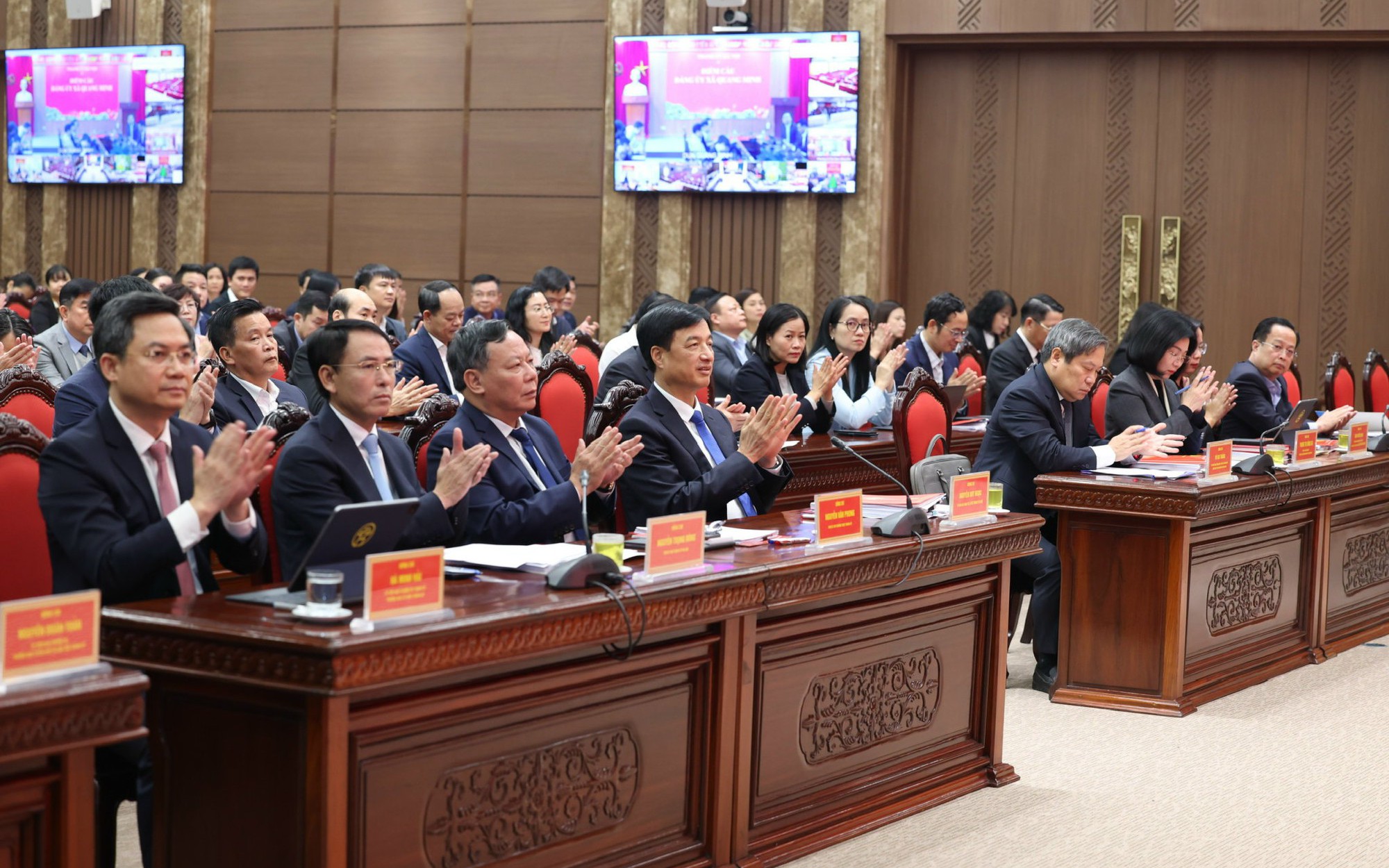
Delegates at the meeting.
Also in attendance were members of the Standing Board of the Hanoi Party Committee, members of the municipal Party Committee and standing leaders of Party organizations under the city Party Committee, as well as representatives from 126 communes and wards.
This marked the first time Hanoi has held a citywide annual review conference in a hybrid format, combining in-person and online participation, replacing nearly 1,600 separate meetings previously organized by agencies and sectors from the city level to grassroots units.
The conference reflected a strong spirit of reform and innovation, saving time, effort and costs while marking a turning point in how annual reviews, experience sharing and task deployment are organized. The new approach ensures greater consistency, comprehensiveness and unified direction across the entire political system.
Ten standout results in 2025
The year 2025 held special significance for Hanoi, marked by historic tasks, a heavy workload and a series of urgent, unprecedented challenges. Despite mounting pressures, the city pressed ahead with determination and innovation, overcoming difficulties to deliver important and comprehensive results, reflected in ten key highlights.
First, Hanoi renewed its leadership mindset and governance methods, delivering marked improvements in execution across the political system. This helped ignite a stronger spirit of action and enhanced coordination among four core pillars: the Party, the People’s Council, the People’s Committee, and the Fatherland Front and socio-political organizations, under the Party’s comprehensive leadership and flexible adaptation to a new development phase.
Second, the city pushed ahead decisively with reforms to streamline the organizational apparatus of the political system and effectively operate the two-tier local government model. These efforts produced clear gains in governance efficiency, strengthened people-centered administration, and improved services for residents and businesses with measurable outcomes.
Third, Hanoi successfully organized Party congresses at all levels, alongside congresses of the Fatherland Front and socio-political organizations for the 2025–2030 term. Following the events, resolutions were swiftly translated into concrete action.
Fourth, the capital took a pioneering role in implementing seven strategic resolutions of the Politburo, along with key directives from the Party Central Committee and the General Secretary.
Fifth, the city concentrated on addressing five long-standing bottlenecks, while reviewing and upgrading institutions, infrastructure and resources to support development in the new phase.
Sixth, Hanoi organized major national and capital-level commemorative events, including celebrations, parades and marches marking the 80th anniversary of the August Revolution and National Day. These activities generated broad public resonance and underscored the capital’s role and stature.
Seventh, the entire political system was mobilized to sustain economic growth above 8 percent, while state budget revenue surpassed VND600 trillion (US$23.1 billion) for the first time, despite challenging conditions. As of December 25, 2025, GRDP growth reached 8.16 percent year on year, and budget revenue exceeded VND668.5 trillion (US$25.7 billion).
Eighth, Hanoi achieved breakthroughs in land clearance, resolving long-delayed bottlenecks, notably completing clearance for Ring Road 1 within a short timeframe. Strategic projects were accelerated, including the Olympic Sports Urban Area in southern Hanoi and the Red River scenic boulevard.
Ninth, the city continued to assert its leading role in socio-economic development driven by science, technology, innovation and digital transformation. Hanoi ranked first nationwide in the provincial innovation index for the third consecutive year and pioneered the integration of Party administrative procedures into the National Public Service Portal, while accelerating digital transformation across Party agencies and the broader political system.
Tenth, Hanoi strengthened decentralization and delegation of authority to the commune level, delivering initial gains in autonomy and accountability under the principle of local decision-making, local implementation and local responsibility.
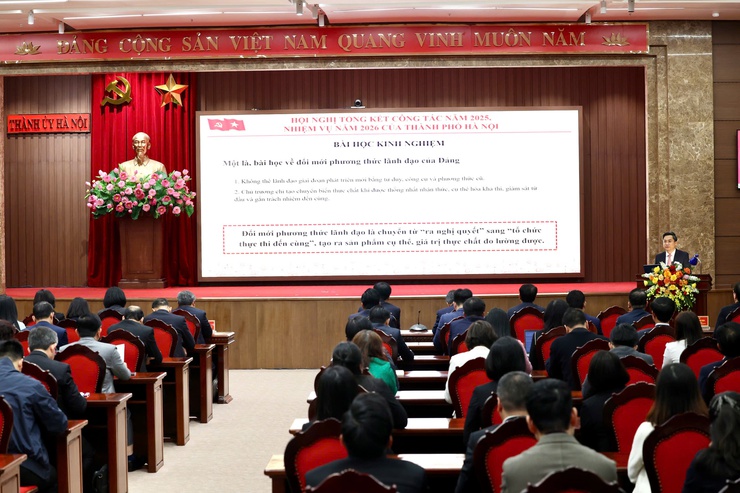
Overview of the meeting.
Establishing a new growth model based on science, innovation and digital transformation
The year 2026 marks the first year of implementing the resolution of the 18th Hanoi Party Congress and the year of the 14th National Party Congress, a milestone signaling the country's entry into a new era.
As the nation's political and administrative center and its symbolic heart, Hanoi bears a pioneering responsibility in implementing the 14th Party Congress resolution, advancing the two centennial goals and translating seven strategic resolutions of the Politburo and directives from the General Secretary into concrete action.
The city has identified key tasks for the new development phase.
Hanoi will continue to renew Party leadership methods and strictly implement resolutions of the 18th Hanoi Party Congress and the 14th National Party Congress, along with guidance from General Secretary To Lam.
Immediate priorities include organizing the 80th anniversary of the first general election in 1946, supporting the 14th Party Congress and successfully holding elections for the 16th National Assembly and People's Councils for the 2026–2031 term.
At the same time, the city will strengthen Party building in ideology, politics, organization and ethics. It will renew inspection and supervision through proactive and data-driven approaches to reinforce discipline and public service accountability and prevent emerging issues at an early stage.
Institutional and planning work will be advanced, with a focus on completing the capital master plan with a 100-year vision, revising Politburo Resolution 15 and implementing the 2024 Capital Law and National Assembly Resolution 258.
Hanoi will further decentralize authority to the commune level in tandem with digital transformation, enabling grassroots political systems to better serve residents and businesses.
The city aims to establish a new growth model based on science, technology, innovation and digital transformation, targeting GRDP growth of at least 11 percent in 2026 and throughout the term.
Strategic infrastructure will be accelerated through major projects, including seven projects launched on December 19, 2025, the Red River boulevard, the Olympic Sports Urban Area, seven bridges across the Red River and key ring roads and radial corridors.
Governance mechanisms covering the full project life cycle and comprehensive social and environmental impact assessments will be strengthened.
Hanoi will intensify efforts in science, innovation and digital transformation under Resolution 57, complete 12 priority tasks and implement the Hanoi smart city scheme.
In land clearance, leadership capacity will be strengthened through clearer responsibilities and expanded use of breakthrough mechanisms such as social housing resettlement and PPP advance funding, alongside stronger communication, dialogue and strict enforcement.
The city will address five persistent bottlenecks covering urban order, traffic congestion, environmental pollution, flooding and food safety, ensuring conditions do not worsen and steadily improve over time.
Finally, Hanoi will pursue balanced cultural and social development, enhance high-quality education and healthcare, ensure social security and protect vulnerable groups so no one is left behind.
National defense and security will be maintained to safeguard key targets and events, while external relations and international integration will be expanded to attract new resources for the capital.