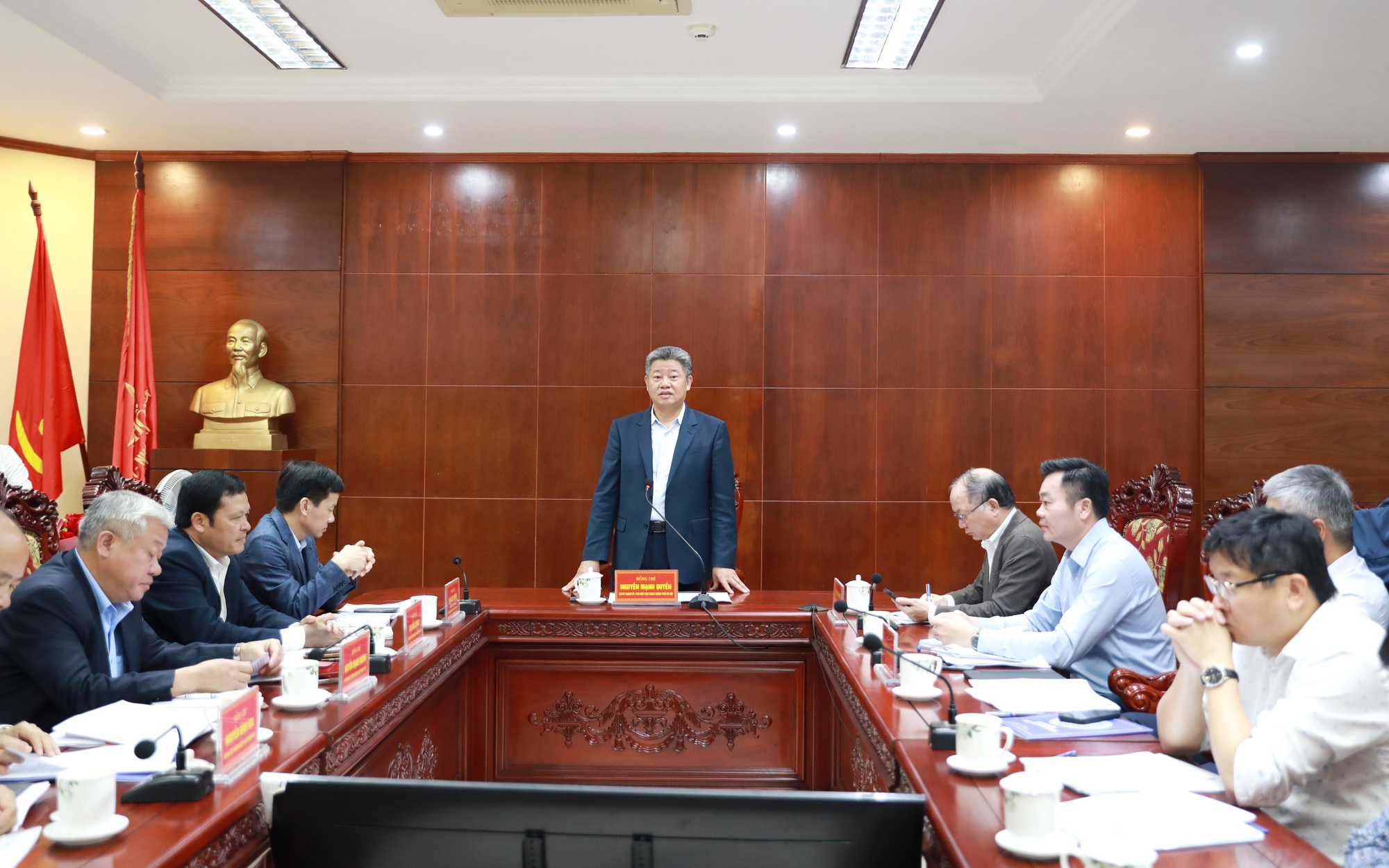
 Vice Chairman of the Hanoi People's Committee Nguyen Manh Quyen chairs the working session.
Focusing on removing environmental and resource bottlenecks
Reporting at the session, Ta Van Tuong, Deputy Director of the Department of Agriculture and Environment, said the department is headquartered at 18 Huynh Thuc Khang Street in Giang Vo Ward and includes a Director and five Deputy Directors, with 25 affiliated units comprising 13 functional divisions, four sub-departments and seven public service units. The department has been assigned 1,879 staff positions and currently employs 1,375 civil servants, public employees and contract workers.
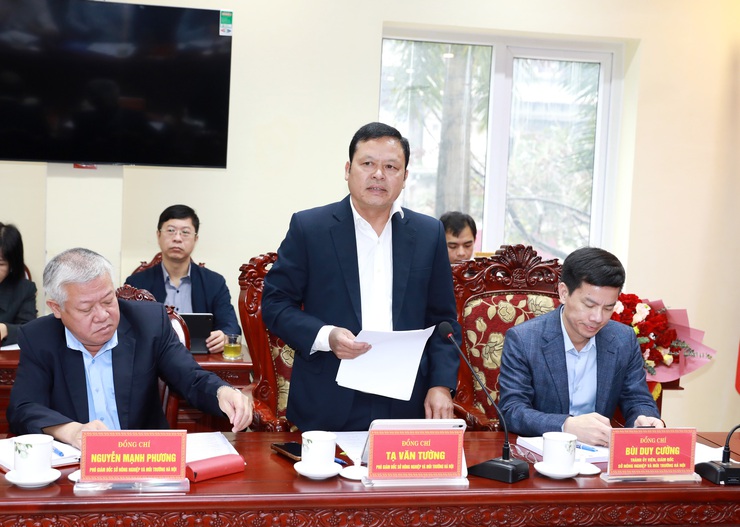 Deputy Director Ta Van Tuong presents his report at the session.
In 2026, the department will focus on addressing environmental and resource bottlenecks, particularly in handling six groups of waste. The city aims to balance municipal solid waste by 2027 at about 7,600 tons per day through waste-to-energy incineration technology. Construction solid waste is targeted to reach balance before December 31, 2026, with a treatment capacity of 3,000 to 4,000 tons per day.
Drainage sludge and construction sludge are expected to reach treatment capacities of 4,000 tons in 2026 and 4,600 tons in 2027. Septic sludge is targeted for full treatment of approximately 1,490 tons generated daily by the end of 2026. Medical waste will continue to be treated at the Cau Dien waste treatment complex and expanded in Nam Son. Industrial waste treatment will be maintained in Nam Son while adding capacity at new facilities.
Notably, the city has proposed developing four construction material storage and recycling depots that capitalize on the advantages of waterway transport to reduce logistics costs and road traffic pollution.
The proposed sites cover approximately 100 hectares in the north, 80 hectares in the west, 100 hectares in the east, and about 120 hectares in the south of the city. Under the plan, the Department of Agriculture and Environment will be responsible for site identification, land preparation, and environmental impact assessments, while the Department of Construction will call for investment and oversee operations.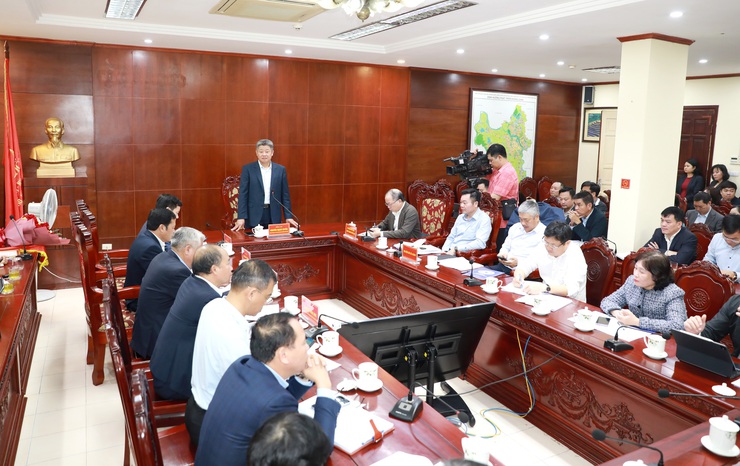 Overview of the working session.
Regarding air pollution control, the department has developed an action program with specific milestones. Interregional coordination regulations will be completed before March 30, 2026. A city-level emission inventory will be conducted in May. An automatic monitoring network of 15 air stations, five surface water stations and six groundwater stations is expected to be completed by November 2026.
The city will pilot a low-emission zone within Ring Road 1 from July 1, 2026, review 53 major emission sources for relocation from urban areas, enhance AI-based monitoring of waste and straw burning and coordinate motorcycle emission inspections from June 2026.
To address water pollution, the city is implementing a plan to restore four inner-city rivers — To Lich, Kim Nguu, Lu, and Set — along with the Nhue–Day and Bac Hung Hai river basins. By 2030, the city aims to complete its planned domestic wastewater treatment system, with an estimated total investment of approximately VND150.5 trillion (US$6.02 billion).
At present, all 10 industrial parks and 41 out of 70 industrial clusters have installed wastewater treatment systems. The remaining 29 clusters are expected to complete installation before 2027, while non-compliant facilities will be required to relocate starting in 2028.
Building a synchronized, modern and transparent land management platform
Speaking at the session, Director of the Department of Agriculture and Environment Bui Duy Cuong said the department is closely coordinating with planning agencies to finalize the capital’s 100-year vision plan and to build a synchronized, modern, and transparent land management system.
In the immediate term, the department is prioritizing the completion of a unified policy framework on additional support for land clearance, which will be submitted to the Hanoi People’s Committee for approval before March 15, 2026. The framework is intended to provide a consistent legal basis for wards and communes to apply across all land categories, from land recovery and conversion to land handover for development projects.
According to Cuong, Hanoi's land data volume is substantial, with a total natural area of 335,984 hectares corresponding to more than 4.18 million land parcels. To date, cadastral spatial data covering about 269,362 hectares, or more than 3.23 million parcels, has been completed, exceeding 80 percent.
The remaining portion mainly involves agricultural land, with nearly 950,000 parcels lacking complete cadastral maps. In terms of attribute data, nearly 2.48 million parcels have been completed, or over 59 percent, including more than 2.19 million parcels that have been cleaned and synchronized with the national population database. The department aims to complete cadastral records for about 600,000 remaining agricultural parcels before June 30, 2026 while continuing updates in parallel.
Cuong affirmed that land data digitization is a key foundation for accelerating land clearance, issuing land use right certificates and handling administrative procedures. The department is reorganizing the land registration office system under a streamlined model with 12 branches linked to a central data center to ensure centralized management while directly serving localities. Data will be shared across departments and local authorities to support digital economic development in land management and enhance revenue generation from land resources.
Regarding land clearance, the director noted that new policy mechanisms under the 2024 Land Law and city resolutions have resolved many obstacles, particularly on compensation and support levels. However, about 20 percent of land recovery cases remain ineligible for compensation under regulations and require alternative support policies. Issuing a unified citywide support framework before mid-March is considered crucial to shorten project timelines.
At the same time, the department will continue land valuation, adjust land price lists and coefficients in 2026 and decentralize to commune-level authorities the determination of starting auction prices in certain cases, to be completed before March 31, 2026. The target is to ensure and exceed land revenue goals, with projected total land revenue in 2026 of about VND150,000 billion (US$6 billion).
The department will also apply digital technology and artificial intelligence to manage forest land and monitor land changes to detect violations early and improve efficiency. It will continue reviewing delayed projects and strictly handle land violations, identifying this as a key task to unlock resources and build a foundation for sustainable long-term development.
Strengthening discipline, digital transformation and effective land utilization
Concluding the session, Vice Chairman of the Hanoi People's Committee Nguyen Manh Quyen emphasized a comprehensive review of organizational structures toward a lean, streamlined and effective model with clear functions and responsibilities.
He called for assessing the land registration office's operations, clarifying legal and practical obstacles and considering leadership with dike management expertise to enhance advisory quality.
The city will restructure units, establish specialized data and digital transformation divisions in land and environment management and consolidate office locations to avoid fragmentation and ensure efficiency.
In the agricultural sector, he called for accelerating the development of centralized safe vegetable production models, promoting land capital contribution schemes, and organizing multi-purpose, high-value production linked to processing and logistics in order to establish specialized production zones.
He stressed that the use of riverbank and agricultural land must be clearly zoned for crop production, livestock farming, and flower cultivation, with appropriate supporting infrastructure to prevent uncontrolled construction. Programs such as new-style rural development and the One Commune, One Product (OCOP) initiative should continue to be implemented effectively, with stronger interdepartmental coordination.
For dike management, irrigation and disaster prevention, the city requires proactive handling of flooding, the development of climate-resilient green infrastructure, adequate materials for dike protection and the planning of material storage depots and concrete mixing stations in line with the planning.
Coordination with upstream provinces must be strengthened for flood prevention while implementing the "streets in the forest, forest in the streets" approach to urban tree development, ensuring proper species selection and sustainable growth.
Regarding land, resource and data management, he reaffirmed this as a central focus requiring decisive action, especially on issuing land use right certificates to complete and enrich land data. Eligible cases must be resolved thoroughly, and backlogs reviewed and handled in accordance with regulations.
The city will review scattered land and underutilized production land to form forest and green land funds and nursery areas while building comprehensive specialized databases on maps, engineering geology, hydrology, defense land, religious land, forests and irrigation, integrated with digital transformation in parcel management and online planning lookup.
In environmental management, forests and construction materials, the city requires review of polluting facilities, investment in waste and air monitoring systems to identify emission sources, development of nurseries and conservation of suitable urban tree species, including rare species. It also calls for studying material storage and recycling facilities to reduce shortages and urgently finalizing pending unit prices and norms.
Quyen stressed the overarching requirement to enhance discipline and administrative order under the principle that each task must be fully completed before moving to the next. Coordination among departments must be strengthened to ensure unified responsibility in submissions to the Hanoi People's Committee.
Tasks related to Resolution 57 and digital transformation must be implemented immediately, while dike management, agriculture and environmental resources must be executed synchronously and effectively toward sustainable development and improved urban governance.
He also requested the mobilization of social resources, shortening investment procedures and accelerating environmental treatment projects to gradually remove bottlenecks, improve environmental quality and ensure the sustainable development of the capital in the coming period.