At the meeting, Party Secretary and Chairman of the Commune People's Council Trinh Tien Tuong said that after the administrative reorganization, Phu Nghia Commune maintained smooth and uninterrupted operations, which supported stable socio-economic development and a positive shift in its economic structure.
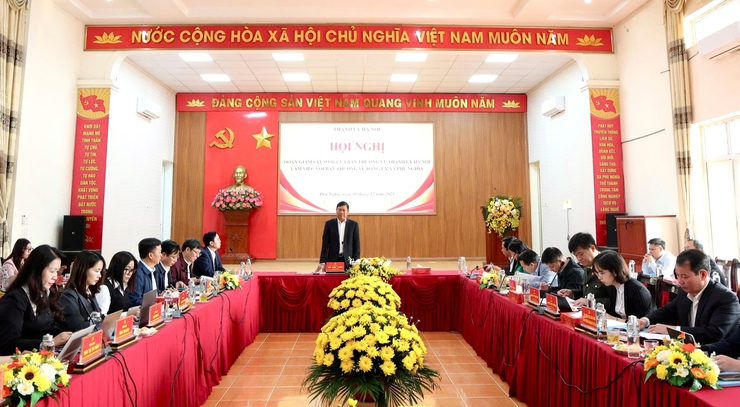
Overview of the meeting.
He noted that in 2025, the commune completed all 13 targets assigned by the city, with four exceeding plans. The total value of local production grew by 8.5 percent. The Commune People's Committee issued more than 5,000 official documents, including 42 key directives that detailed tasks for each sector, while the commune's Fatherland Front Committee issued 21 documents.
Regarding public investment, the commune was assigned nearly VND278 billion (US$11.12 million) for 67 projects. As of November 30, it had disbursed almost VND145.3 billion (US$5.81 million), equivalent to 52.25 percent of the allocated capital, and aims to raise disbursement to 99 percent in the coming period.
Site clearance advanced across 11 projects in the commune. Nine projects span a total of 144,517.6 square meters, with three—covering 13,467.44 square meters—already completed. Six projects totaling 131,050.06 square meters remain in progress.
The commune is also handling one off-budget project, the Dong Phu Yen Industrial Cluster, which requires land recovery over 416,116.3 square meters.
The commune was assigned more than VND7 billion (US$280,000) in state budget revenue and expects to collect over VND20.6 billion (US$824,000), reaching 294.3 percent of the target. Commune budget revenue for 2025 is estimated at more than VND445.2 billion (US$17.81 million). Average annual income stands at nearly VND85 million (US$3,400) per person, with no poor households. All residents have access to clean water, local healthcare meets national standards, and all 19 schools meet required education coverage.
Digital transformation also advanced. All 431 administrative procedures are publicly listed and accessible online, and 62.4 percent are processed online, with all submissions handled on time. In 2025, the commune’s citizen satisfaction score reached 94.72 out of 100, ranking 18th among 126 communes and wards in Hanoi.
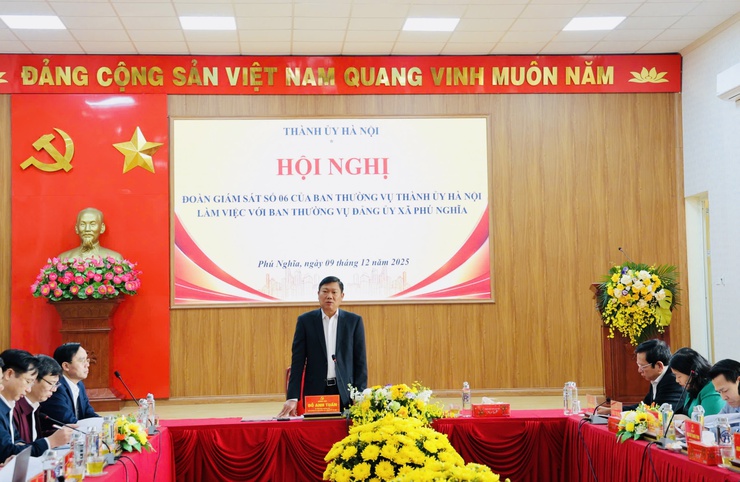
Delegates at the meeting.
Social welfare programs were fully implemented, with health insurance coverage reaching 95.3 percent. Cultural titles were awarded to 94.3 percent of households and 94.4 percent of villages. Local security and social order remained stable, with no large or prolonged petitions or escalated complaints recorded.
Party-building efforts also posted strong results, exceeding the target for new party members. Inspections and supervision followed plan, and party cell activities improved in substance.
At the meeting, Phu Nghia leaders outlined several challenges. Some government office facilities are deteriorating without allocated funds for repairs. Supporting infrastructure has not kept pace with rising local needs. Equipment at the commune level remains insufficient, and information technology infrastructure is still limited. The commune requested additional staffing for the education sector and asked for city approval to sign contracts under Government Decree 173/2025, as well as permission to organize recruitment for education personnel soon.
Members of the supervisory delegation exchanged views, identified shortcomings and proposed solutions to help the commune address obstacles and improve performance.
In his conclusion, Standing Committee member and Chairman of the Municipal Inspection Commission Do Anh Tuan commended the proactive and determined efforts of Phu Nghia Commune in carrying out tasks for 2025, particularly in digital transformation, which he described as a continuous requirement across all areas of grassroots governance.
He stressed that digital transformation is not only about technology but also about changing mindsets and work methods to reduce procedures, eliminate unnecessary steps and improve public services. Drawing on practical experience in digital economic development, he noted that grassroots authorities can create new value if they make full use of local potential and support residents and businesses.
He underscored that civil servants must master their duties, respond flexibly and reorganize procedures so they are simple to understand, easy to implement and easy to supervise. He also asked Phu Nghia Commune to continue strengthening planning, develop clear implementation roadmaps and listen closely to residents to address pressing social concerns.
The head of Supervisory Delegation No. 6 further requested the commune to prepare the contents of its eight thematic reports more thoroughly, in line with the delegation’s outline. Based on the delegation’s comments, he said the commune’s Standing Committee should clarify and deepen solutions within its authority and highlight lessons learned and effective practices from 2025 to apply in 2026.
On behalf of the Standing Committee of the Phu Nghia Commune Party Committee, Party Secretary and Chairman of the Commune People’s Council Trinh Tien Tuong expressed appreciation for the delegation’s guidance, especially the directions of the Chairman of the Municipal Inspection Commission. He said the commune will incorporate all comments to finalize the eight thematic reports and submit concrete proposals to improve task implementation in the coming period.