Speaking at the event, which was held at the Special National Historic Site of Hai Ba Trung Temple-Pagoda-Communal House, Nguyen Quang Trung, Deputy Secretary of the District Party Committee and Chairman of the People's Committee of Hai Ba Trung District, emphasized that 1,985 years ago, in the year 40 AD, under the brutal oppression and exploitation of the Eastern Han Dynasty, Trung Trac and her younger sister Trung Nhi raised the flag of rebellion, calling upon heroes from all over the nation to rise against the Han rulers.
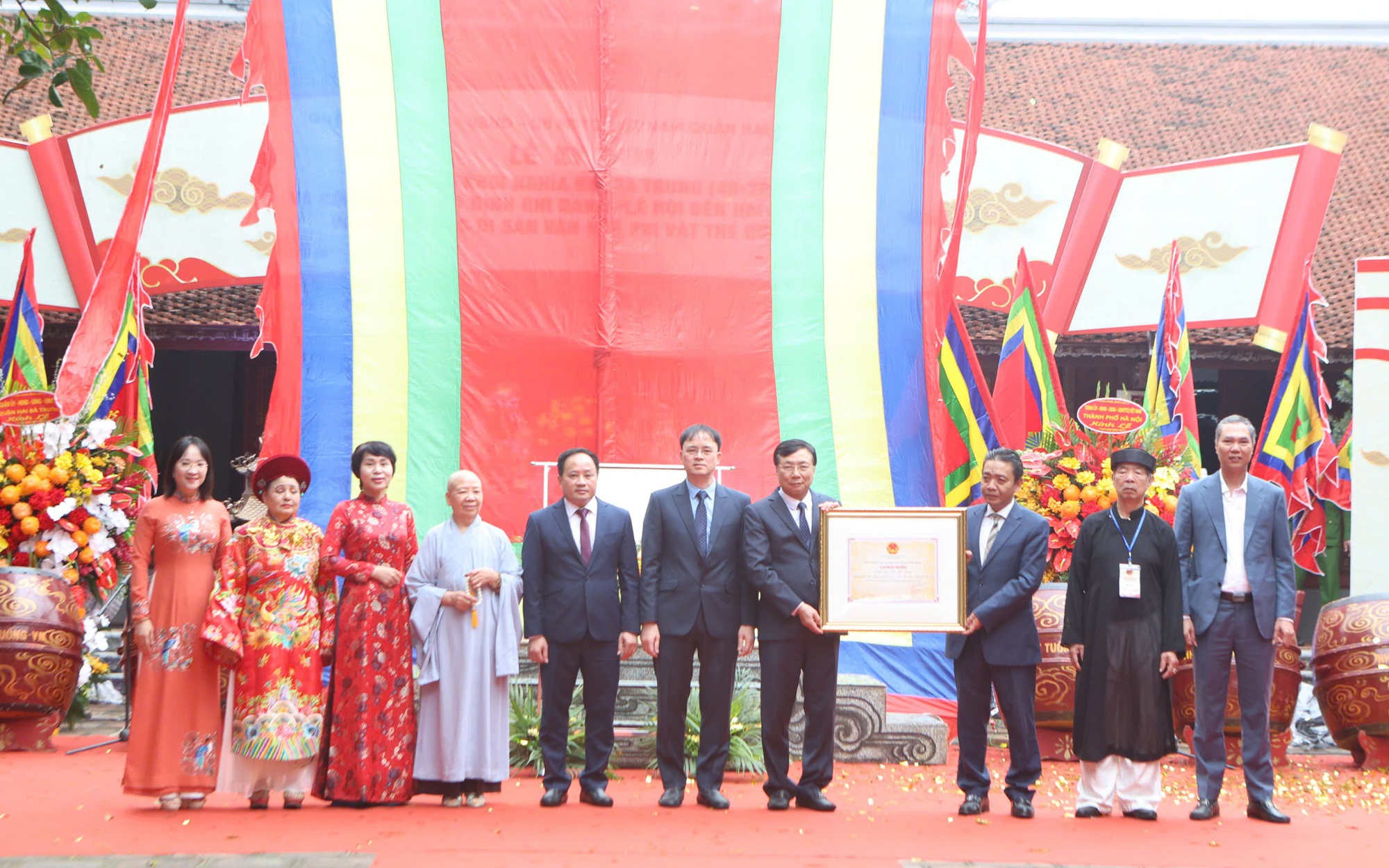
Overview of the event.
The uprising received overwhelming support from the people, forming an unstoppable force. Wherever the Hai Ba Trung army advanced, the Han administration and military forces collapsed.
In a short period, the sisters successfully seized control of 65 districts and strongholds, effectively liberating the entire territory of Vietnam at the time. The Han governor, Su Ding, fled back to China, ending the harsh colonial rule of the Eastern Han. With the country freed, Trung Trac was honored by her generals and the people, who proclaimed her Queen, taking the title of Trung Nu Vuong and establishing the capital in Me Linh. After ruling for three years, in 43 AD, the Han army returned, and the Hai Ba Trung sisters once again led the resistance.
On the 6th day of the second lunar month in the Year of the Water Cat, according to legend, after a fierce battle, refusing to be captured by the enemy, the sisters sacrificed themselves by jumping into the Hat River. Their spirits are said to have turned into stone statues, which drifted down to Dong Nhan village. The villagers of ancient Dong Nhan conducted a ritual with red fabric to bring the statues to shore. In 1142, King Ly Anh Tong ordered the construction of a temple in their honor by the riverbank. In 1819, due to riverbank erosion, the temple was relocated to the Vo Mieu area in Huong Vien village, Tho Xuong district, now Dong Nhan ward, Hai Ba Trung district.
Throughout history, the heroic image and immense contributions of the Hai Ba Trung sisters have remained deeply ingrained in the memory of the Vietnamese people. The Special National Historic Site of Hai Ba Trung Temple-Pagoda-Communal House has become a sacred destination, symbolizing the gratitude of successive generations to the two national heroines.
Every year, the Hai Ba Trung Temple Festival is held with grand traditional ceremonies, attracting numerous locals and visitors who come to offer incense, pay respects, and commemorate the sisters' legacy.
The temple-pagoda-communal house complex is a rare and unique cultural site in the heart of the capital, with the Hai Ba Trung Temple standing out for its distinctive "inner sanctuary, outer citadel" architectural style. Inside the temple are many valuable artifacts, including 27 royal decrees from the Le and Nguyen dynasties, eight worship statues, two ancient stone steles recounting the sisters' history, and two Nguyen dynasty palanquins.
The complex is situated on a site believed to be blessed with auspicious energy, bringing peace and prosperity to the local community. In recognition of its historical significance, in 2019, the Vietnamese Prime Minister officially designated the Hai Ba Trung Temple-Pagoda-Communal House as a Special National Historic Site.
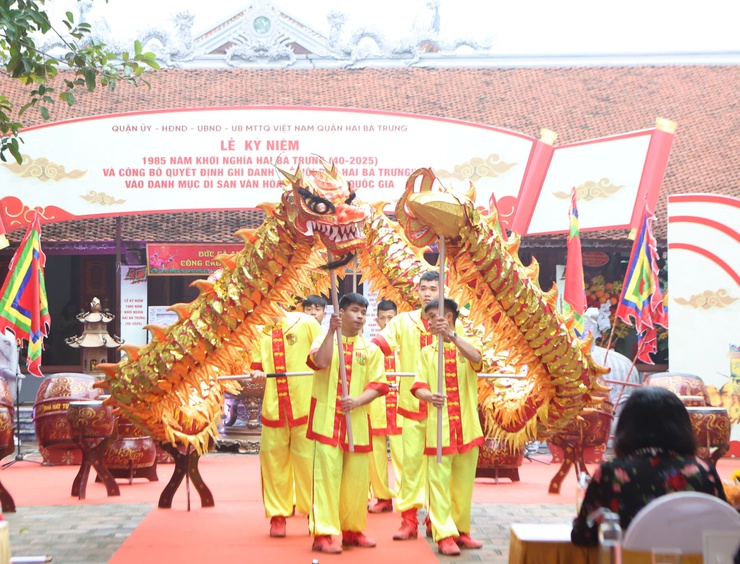
Art performance at the event.
Beyond its architectural and artistic value, the Hai Ba Trung Temple complex holds rich cultural significance. The Hai Ba Trung Temple Festival is uniquely held across three locations in Hanoi, reflecting the deep-rooted connections among local communities and their reverence for the two queens.
The annual ceremonial rituals, conducted with solemnity and adherence to traditional practices, include the sacred water procession, where water from the Red River is brought to the temple for the ancient purification ceremony.
With its profound cultural value, contributing to the nation's rich heritage, the traditional Hai Ba Trung Temple Festival has been officially inscribed in the National Intangible Cultural Heritage list by the Ministry of Culture, Sports, and Tourism. The Special National Historic Site of Hai Ba Trung Temple-Pagoda-Communal House has also been recognized as a tourist attraction by the Hanoi People's Committee.
Chairman of the Hai Ba Trung District People's Committee stated: "As proud descendants of the Hai Ba Trung sisters, continuing the resilient tradition of these national heroines, in recent years, the Party, government, and people of Hai Ba Trung District have remained united, striving to develop the economy, ensure political security, maintain social order and safety, and improve the overall quality of life."
During the 2020-2025 term, the district successfully met and exceeded 18 out of 19 targets set by the Party Congress resolution, with some goals achieved ahead of schedule by over a year. The district's development has been evident across various aspects of social life, including economic recovery and high growth rates. Annual budget revenue has consistently exceeded projections, making Hai Ba Trung one of the five highest-contributing districts in Hanoi. Infrastructure development and urban planning have been actively upgraded and modernized.
The preservation and promotion of cultural and historical values have been reinforced. Public healthcare services have improved, ensuring social welfare and enhancing the quality of life for residents. Breakthroughs have been made in administrative reform, digital transformation, e-government development, and urban infrastructure investment. The district has also made significant strides in improving education quality and workforce training, making it worthy of bearing the esteemed name of the two national heroines.