Secretary of the Party Committee and Chairman of the Commune People's Council Dang Duc Quynh reported that total budget revenue in 2025 is estimated at VND451.673 billion (US$18.07 million), equal to 116% of the plan, while total expenditure is VND386.523 billion (US$15.46 million), equal to 99% of the plan, including VND26 billion (US$1.04 million) for development investment, meeting 100% of the target.
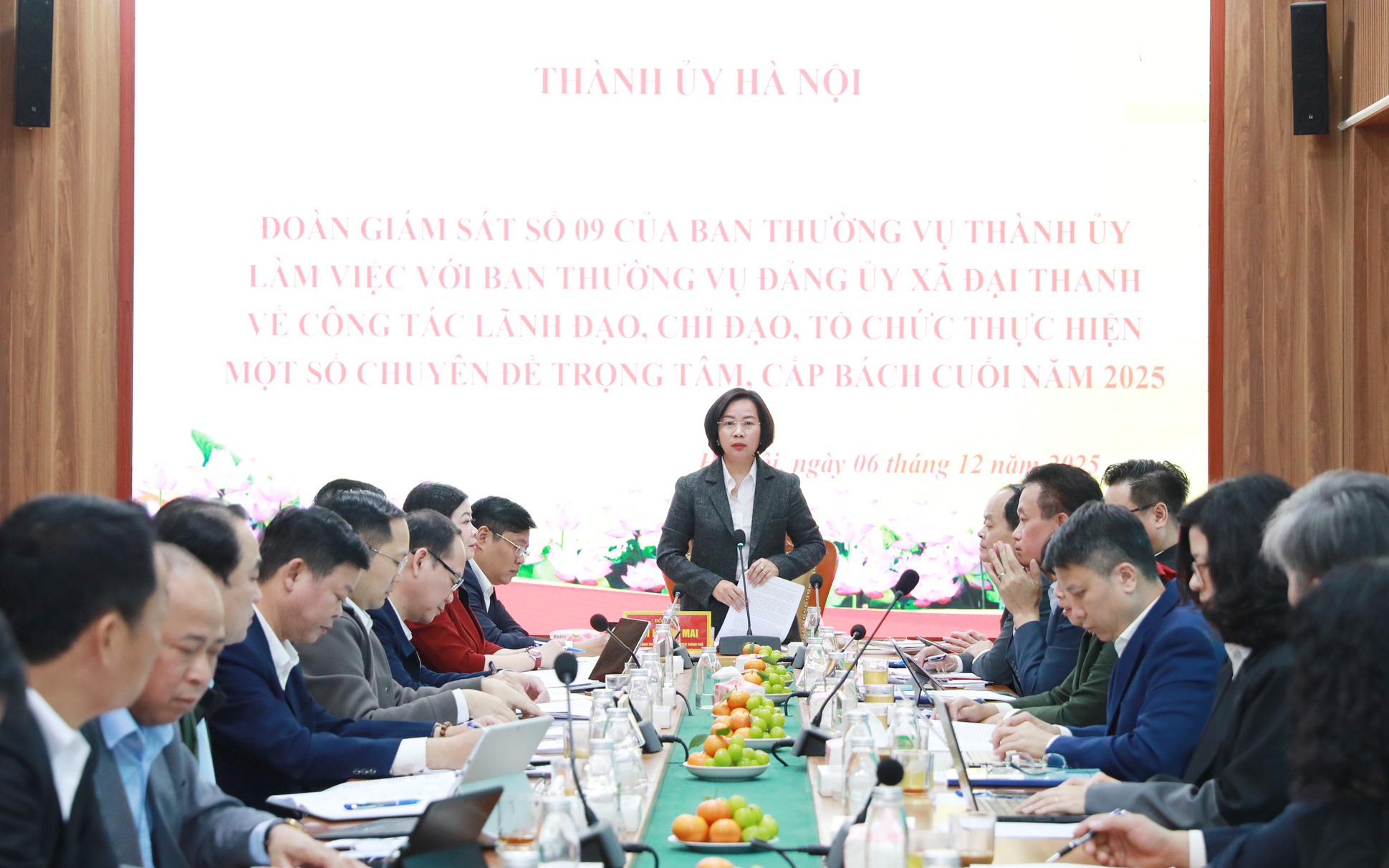
Overview of the meeting.
Average income per capita reached VND82 million (US$3,280) per person per year and the commune has no poor or near-poor households. All residents have access to clean water and 19 out of 20 public schools meet national standards, including 11 schools meeting level 2 standards.
The commune has introduced a Community Public Service Point at Dai Thanh Urban Area, which makes it easier for residents to access public services. From July 1, 2025, the commune received 4,967 applications and resolved 4,538 on time or ahead of schedule, equal to 91.36%, while its public service index reached 91.2 out of 100 points and ranked 118 out of 126 localities.
From July 1 to November 30, 2025, the commune received 5,851 applications of which 69.58% were submitted online and all were resolved on time or ahead of schedule. Citizen satisfaction on the National Public Service Portal reached 18 out of 18 points.
Regarding public investment disbursement, as of November 30, 2025 the commune had disbursed VND307.934 million (US$12,317), equal to 70.17% of its allocated capital and expects to meet 100% of the assigned plan by year end.
Reporting on pressing local issues, Secretary Dang Duc Quynh said the commune has proactively addressed flooding and reduced local inundation, limiting its impact on residents. There are no prolonged traffic congestion points and the commune has focused on environmental sanitation, water and air pollution control and urban order.
Alongside these results, Dai Thanh faces many challenges as rapid urbanization has put pressure on the environment, traffic, population, public services, land procedures, construction management, residency and social security. Staffing, facilities and IT infrastructure remain limited and uneven, and digital literacy among some officials and residents varies widely while many still prefer direct transactions and paper documents. Several administrative regulations and processes are still being updated.
Representatives of municipal departments and the supervisory team acknowledged the commune's results and its flexible approach during the early phase of the new two tier local government model. They requested the commune to clarify issues related to digital transformation, delegated authority and staffing, and to identify specific obstacles and recommendations for each thematic area so that tasks can be implemented effectively.
Deputy Secretary of the Party Committee and Chairman of the Commune People's Committee Nguyen Van Hung addressed questions regarding staffing and land clearance compensation. He said current compensation policies are not aligned with local conditions and relocating graves for site clearance remains difficult. He proposed reviewing and expanding the existing cemetery to create additional resettlement space for relocated graves.
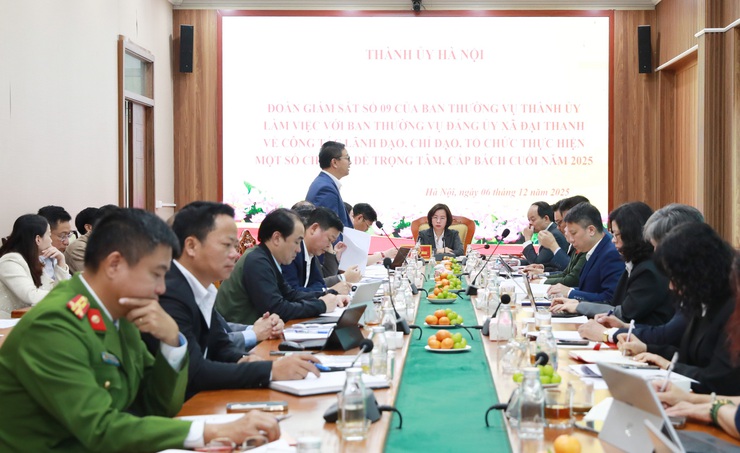
Overview of the meeting.
He also explained delays in some administrative procedures related to land and civil status, noting that applications cannot be finalized because residents have not completed their financial obligations even though the commune has fulfilled all administrative steps. He suggested amending the process so that once the commune completes its required steps the system records the application as completed.
In her conclusion, Chairwoman of the Vietnam Fatherland Front Committee of Hanoi Bui Huyen Mai praised Dai Thanh Commune for implementing eight thematic tasks in a disciplined and comprehensive manner within a short timeframe and under high requirements.
She also recognized the effectiveness of the Community Public Service Point model at Dai Thanh Urban Area, which has improved convenience for residents and reflects the strengths of the two tier local government model.
She pointed out several shortcomings, including delays in some thematic tasks and uneven IT skills among officials. She emphasized that while some limitations stem from objective factors, each official must work to improve their skills to meet task requirements.
She asked the commune to study the structure of the eight thematic tasks carefully and present detailed recommendations grouped by competent authority to enable timely solutions.
She instructed the Standing Board of the Commune Party Committee to continue reviewing and resolving remaining shortcomings, developing a detailed remediation plan with clear timelines and assigning individual responsibility for each task, along with regular monitoring.
"This is an opportunity to assess more than five months of operation under the two tier local government model and to review regulations to ensure smooth and effective administration," said Mai.
"The commune must identify suitable management methods and persistently address bottlenecks, adding that no problem can be resolved if the commune does not confront it directly," said Mai
With New Year and Lunar New Year 2026 approaching, she asked Dai Thanh Commune to ensure social welfare so that all vulnerable groups and disadvantaged residents receive support.
She stressed that this Lunar New Year should be different from previous years because it marks the first Tet under the new two tier local government model and that every resident must feel that the new commune government is closer and more responsive.
She also requested the commune to prepare for the upcoming elections of the National Assembly and People's Councils at all levels, paying attention to personnel, petition handling and IT application.
"The commune must establish a channel to monitor public sentiment to resolve difficulties early and prevent any hotspot from forming, especially during the election period," said Mai.