Attending from the central government were Party Central Committee member and State Bank of Vietnam Governor Nguyen Thi Hong, Minister of Agriculture and Environment Tran Duc Thang and representatives of central agencies, including the National Assembly's Law and Justice Committee, Economic and Financial Committee, the National Assembly Office and the ministries of Justice, Finance and Construction.
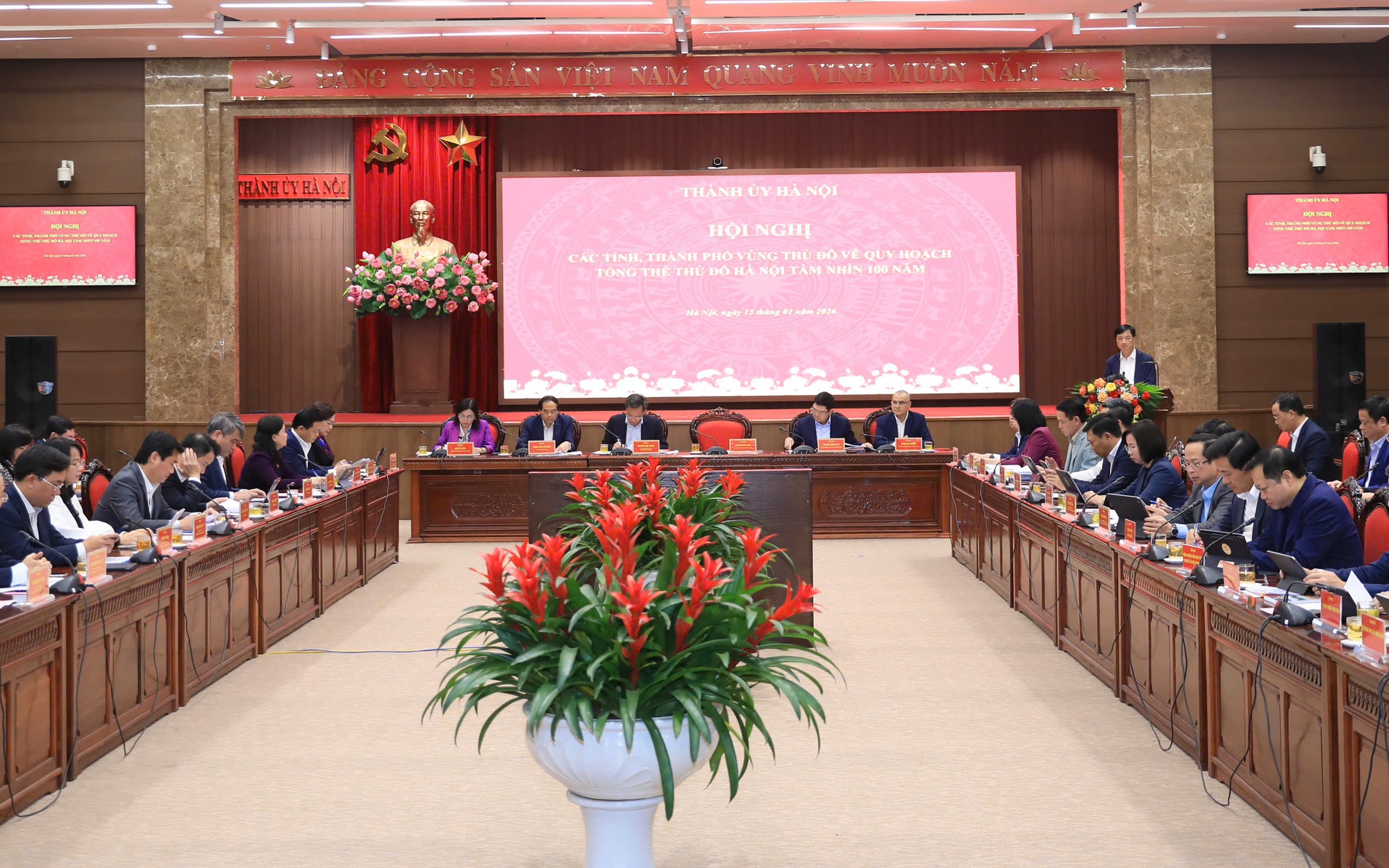
Overview of the meeting.
Hanoi's delegation included Party Central Committee member, Deputy Secretary of the Hanoi Party Committee and Chairman of the Hanoi People's Committee Vu Dai Thang, Deputy Secretary of the Hanoi Party Committee and Chairwoman of the Hanoi People's Council Phung Thi Hong Ha, Deputy Secretary of the Hanoi Party Committee Nguyen Trong Dong and members of the Standing Board of the Hanoi Party Committee as well as leaders of the People's Council, People's Committee and city departments and agencies.
From other localities, attendees included Party Central Committee members Nguyen Huu Nghia, Secretary of the Hung Yen Provincial Party Committee, Nguyen Hong Thai, Secretary of the Bac Ninh Provincial Party Committee and Pham Dai Duong, Secretary of the Phu Tho Provincial Party Committee. They were joined by Thai Nguyen Party Secretary Trinh Xuan Truong, Standing Deputy Secretary of the Ninh Binh Provincial Party Committee Dinh Thi Lua, members of the standing boards of Hung Yen, Bac Ninh, Thai Nguyen, Ninh Binh and Phu Tho and leaders of the Hai Phong People's Committee.
Under the adjusted national master plan, Vietnam will be reorganized into 34 provinces and centrally run cities and six key economic regions. In this structure, Hanoi serves as the center of the Red River Delta Region, linking with Thai Nguyen, Bac Ninh, Hai Phong, Quang Ninh, Hung Yen and Ninh Binh and as the core of the Hanoi Capital Region, linking with Phu Tho, Thai Nguyen, Bac Ninh, Hung Yen and Ninh Binh. Hanoi's development space will be expanded and more closely integrated with surrounding subregions.
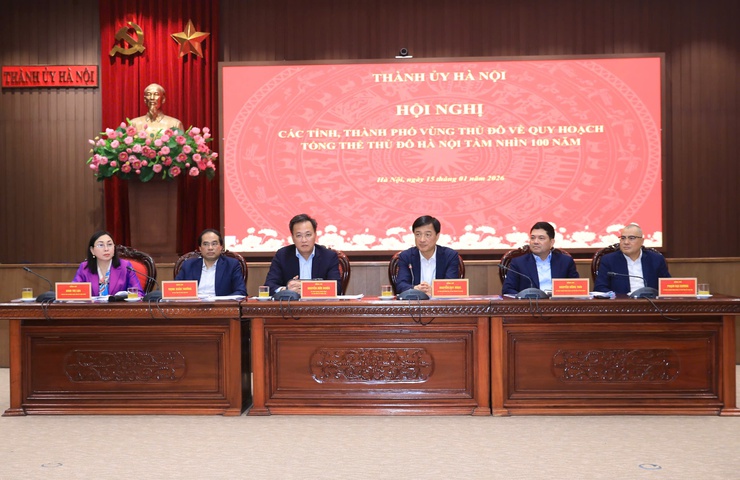
Delegates at the meeting.
With Thai Nguyen and Bac Ninh, Hanoi will form an urban, industrial and high-tech service chain along the north–south economic corridor, Ring Road 3 and National Highways 1B, 3 and 18.
With Hung Yen, Hai Phong and Quang Ninh, connectivity will be strengthened through the Lao Cai–Hanoi–Hai Phong–Quang Ninh economic corridor, Expressway 5B and Ring Road 4 to create a growth axis for border trade, the marine economy and logistics.
With Ninh Binh, links will be developed along the north–south axis, including National Highway 1A, the Phap Van–Cau Gie–Ninh Binh Expressway, the northwest expressway and Ring Road 5 to form corridors for supporting industries, cultural and spiritual tourism and high-quality healthcare.
With Phu Tho, connectivity will be enhanced along the trans-Asia corridor from Noi Bai to Lao Cai, supporting eco-tourism, mechanical engineering and supporting industries.
In the capital's master plan, Hanoi is positioned as the central hub, the main growth engine and the coordinating force that drives and spreads development across the Capital Region and beyond.
The plan defines the Hanoi urban region under a "centralized urban cluster" model, with Hanoi as the core city and surrounding provincial cities serving as major satellite urban centers. These satellites are designed to be interconnected and complementary, sharing resources and creating shared momentum for regional and national development.
Regional-level satellite urban systems will be developed along key corridors. To the north is Thai Nguyen with Thai Nguyen City, Song Cong and Pho Yen. To the northeast is Bac Ninh with Bac Ninh City, Tu Son and Thuan Thanh. To the southeast is Hung Yen with Van Giang, My Hao, Pho Noi and Pho Hien. To the south is Ninh Binh with Duy Tien, Phu Ly, Ninh Binh City and Tam Diep. To the west is Phu Tho with Vinh Yen, Phuc Yen, Viet Tri, Hoa Binh and Luong Son. To the east are Hai Phong City and the urban areas of Hai Duong and Chi Linh.
The plan also outlines buffer zones for Hanoi's development, including western and northwestern buffers, southern buffers and eastern and southeastern buffers.
Through this regional linkage structure, Hanoi aims to address challenges related to transport, the environment and service provision while expanding development space in a sustainable manner. The approach is expected to ease pressure on the capital while creating new growth opportunities and shared benefits for surrounding provinces.
At the meeting, participants also heard a summary report on proposals to draft a new Politburo resolution to replace Resolution No. 15-NQ/TW and to amend the Capital Law.
In discussions, representatives from central ministries and localities expressed broad agreement with and appreciation for the draft proposals on the 100-year capital master plan and the orientation for revising Resolution 15-NQ/TW and the Capital Law. They emphasized Hanoi's role as the central nucleus and growth pole in driving development across the Capital Region and nationwide and in strengthening international integration.
Hung Yen Party Secretary Nguyen Huu Nghia said the province has identified comprehensive connectivity with Hanoi as a consistent planning priority for 2021–2030, including plans for six bridges across the Red River. He proposed adding Trieu Duong Bridge to connect Hung Yen's Provincial Road 427 with Thuong Tin District in Hanoi and clarifying the alignment of Dong Ninh Bridge to connect Provincial Road 429 with Hung Yen's heritage route in line with Hanoi's Ring Roads 4 and 5.
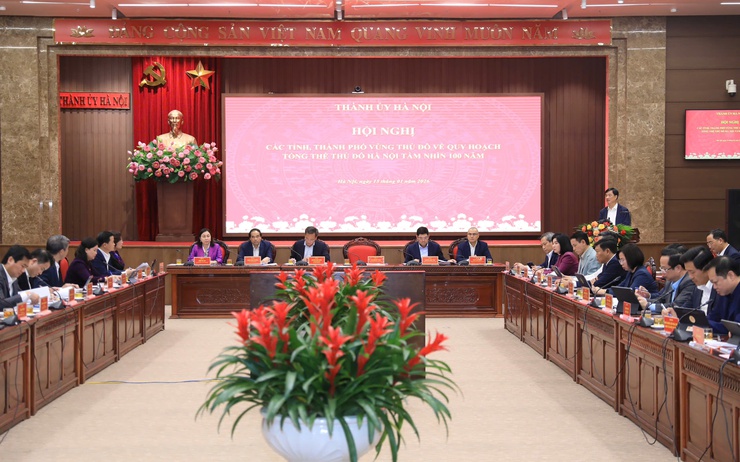
Overview of the event.
He also urged greater attention to underground space and urban rail systems. Hung Yen has planned five urban rail lines largely oriented toward Hanoi and he proposed that Hanoi's metro lines, particularly Line 8, be designed to connect seamlessly with Hung Yen's system. This would facilitate travel, support population redistribution and reduce pressure on Hanoi's inner city. He also called for better use of inland waterways, especially along the Red River.
Nguyen Huu Nghia further suggested that Hanoi manage development strictly in line with approved plans and that revisions to Resolution 15-NQ/TW and the Capital Law grant stronger authority to the capital, paired with robust oversight mechanisms. He proposed establishing a legally binding coordination mechanism for the Capital Region, with Hanoi as the center, to address past shortcomings in regional linkage.
Deputy Minister of Finance Tran Quoc Phuong praised the capital's master plan for its thorough preparation and long-term vision that balances socio-economic development with urban and rural planning. He said the next phase should focus on building a solid legal foundation for sub-area and detailed planning to ensure consistency across planning levels and suggested engaging specialized consultants to ensure quality and feasibility.
He also stressed the importance of public disclosure and communication of the plan and proposed developing a physical planning model to make the master plan more accessible and easier for residents to understand and monitor.
On regional coordination, Tran Quoc Phuong said cooperation between Hanoi and neighboring provinces should be deepened to ensure consistent planning perspectives and directions. He called for a more effective regional coordination model with clear commitments to address fragmented and uncoordinated implementation.
Phu Tho Party Secretary Pham Dai Duong noted that the province borders Hanoi for about 290 kilometers and is traversed by the Red and Da rivers. He urged stronger coordination on cross-regional issues, particularly the environment, transport, population distribution and industrial development. Phu Tho has adjusted its industrial zone strategy to ease pressure on Hanoi's inner areas and to leverage spillover effects from the Hoa Lac High-Tech Park into adjacent zones, including high-tech urban and industrial development and backup data centers.
He proposed three priorities. First, Hanoi should share detailed planning for both banks of the Red River so Phu Tho can extend riverfront landscape planning up to Viet Tri, ensuring consistency along the roughly 70-kilometer stretch. Second, the two sides should jointly develop river-based tourism routes along the Red and Da rivers from Lao Cai through Phu Tho to Hanoi. Third, a coordinated investment mechanism is needed for border areas such as Ba Vi to ensure unified spatial development.
Minister of Agriculture and Environment Tran Duc Thang expressed strong support for the draft capital master plan and the proposed revisions to Resolution 15-NQ/TW and the Capital Law. He praised the drafting agencies for their structured approach and rapid progress on tasks of major significance for Hanoi and the broader region.
He noted that many elements of the draft relate directly to his ministry's responsibilities, particularly land-use planning, agricultural and forest land, water and mineral resource management and environmental protection. These are pressing issues not only for Hanoi but also for neighboring localities and require close and coordinated action.
He proposed strengthening coordination between central authorities, Hanoi and surrounding provinces on key environmental tasks. In the first quarter of 2026, the ministry will work with localities to pilot improvements to the Bac Hung Hai river system, focusing on dredging and improving water flow to gradually address pollution. Central funding will be allocated for dredging while local governments are expected to invest along the corridor to achieve lasting environmental outcomes.
He also emphasized forest management and protection and reaffirmed the ministry's commitment to working closely and responsibly with Hanoi and neighboring provinces to finalize the plan and implement it once approved.
Concluding the meeting, Hanoi Party Secretary Nguyen Duy Ngoc said the city has actively sought input from top Party and State leaders and central agencies on the capital's 100-year master plan, the replacement of Resolution 15-NQ/TW and amendments to the Capital Law to serve development goals for Hanoi, the region and the country in a new era.
He said the feedback offered at the meeting was substantive and forward-looking, reflecting that this is a shared task for all regional localities rather than Hanoi alone. The plan, he added, positions Hanoi not only at the national level but with a vision to reach global standards.
Nguyen Duy Ngoc said Hanoi will fully absorb the feedback and called on central agencies and regional localities to continue contributing ideas to refine the institutional and planning drafts. He suggested that provinces establish working groups to coordinate with Hanoi's agencies on defining development tasks for the coming period.
He stressed that future regional linkage proposals should be built on common standards in areas such as urban rail, inland waterways, roads, metro systems and river environmental management.
Providing an update, he said the amended Capital Law will be submitted for consultation with the National Assembly Standing Committee and central agencies in the first quarter of 2026 and then presented to the first session of the 16th National Assembly. The proposal to replace Resolution 15-NQ/TW will be submitted to the Politburo in February 2026 and the capital master plan with a 100-year vision will be submitted on schedule.
He said the tight timeline requires close coordination and timely input from provinces to help build lasting institutional and planning pillars for the sustainable development of Hanoi and the Capital Region in the new era.