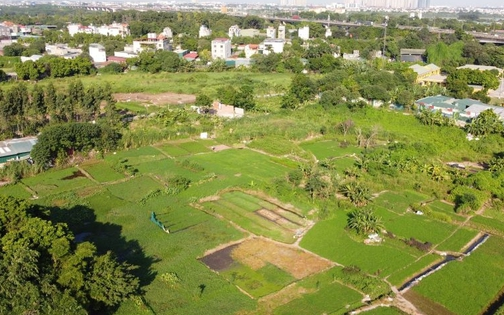
Photo illustration
According to the plan, the city aims to immediately put cadastral survey and documentation results into operation and use them to support state management and administrative procedures, ensuring that data is updated regularly, continuously and synchronously in real time.
The city will develop a land database system that is accurate, complete, clean, live, unified and shared, serving effective management, administration, socio-economic development and digital transformation of the city.
The city will continue maintaining and establishing a multi-sector, multi-level data sharing connection system to ensure data is updated regularly and continuously, enriching the database to meet multi-purpose requirements and integrate into the national database based on existing resources, including human resources, organizational structure and infrastructure while promoting digital transformation.
Responsibilities of departments, agencies and commune-level People’s Committees will be strengthened to ensure coordinated implementation, and unified information technology solutions will be applied to manage and operate the land database.
Specific tasks
The Department of Agriculture and Environment will act as the focal agency and coordinate with departments, agencies, wards, communes and relevant units to immediately select experienced units that understand local conditions and land parcel history across the city to implement urgent tasks that must be accelerated while ensuring quality, efficiency, connectivity and synchronization to meet management, operation and data exploitation requirements.
The department will direct the Hanoi Land Registration Office and its branches to continue reviewing, collecting, completing and standardizing cadastral records and building and completing a unified land database system, and to complete operation of the city’s land database before June 30, 2026.
The department will continue coordinating with the Department of Home Affairs on administrative boundary maps and editing and adjusting cadastral maps according to the two-tier local government model while updating planning information and adjusting maps in line with the progress of major projects.
The department will coordinate closely with the Department of Science and Technology and relevant units to agree on information technology services for building the land database and apply specialized software approved by the Ministry of Agriculture and Environment.
The department will review and evaluate the overall technical infrastructure and software of the current land information system, propose solutions to maintain system management, operation and data sharing through the Land Registration Office system, and link these efforts with human resource training so that the system can be used immediately to meet the schedule for building, completing and operating the cadastral database in the current period.
It will also continue updating and developing additional data layers such as land use planning and land potential assessment in the following years.
Commune-level People’s Committees will assign one Vice Chairman in charge of agriculture and environment as the focal point to receive information and direct timely handling of tasks related to functions, duties and local areas.
They must urgently provide records, data and documents related to land changes and land users, planning documents for projects and works, road and river transport boundaries and land management decisions issued by competent authorities, as well as products from cadastral mapping projects after land consolidation and other projects stored locally.
They will direct departments and relevant sectors to review the current land use status in their areas, confirm land origin, time of land use and dispute status, and coordinate with local police to compare land user information with population database information.
They will coordinate with the Hanoi Land Registration Office and its branches to continue collecting records and documents to enrich and clean the land database and regularly review and update cadastral map data, especially during land clearance, land recovery and land adjustment processes.
They will also coordinate closely with the Department of Agriculture and Environment in determining boundaries, adjusting maps, updating data and completing cadastral records.
Local authorities will regularly conduct communication and information campaigns so that residents and businesses understand the policy, objectives, requirements, importance and benefits of the plan, and provide information on rights and responsibilities of land users before and during the implementation of the plan. Notices, regulations and guidance on land surveying and land change management will be posted at commune and ward People’s Committee offices and public places.
The Hanoi Department of Public Security will standardize land user information using personal identification numbers and ensure security, safety and confidentiality of the city’s operating information systems and develop response plans for possible incidents.
The Public Administrative Service Center will take the lead and coordinate with the Department of Agriculture and Environment to continue reviewing and restructuring administrative procedures related to land, propose prioritizing the development and implementation of fully online public services to reduce paperwork and eliminate the requirement for citizens to submit documents already available in the database, ensuring procedures are simple, convenient, accessible and easy to use for residents and businesses.
The Department of Science and Technology will arrange server infrastructure and transmission systems and coordinate with the Department of Agriculture and Environment to migrate the entire software system and databases to support operation, data exploitation and sharing among departments, agencies and local authorities. The system will be connected and share land data with other databases, initially with the public service portal and connected with tax authorities to create more convenient, faster and transparent administrative procedures for residents and businesses when working with state agencies.