The session included senior officials from several municipal departments. During the meeting, Deputy Director Ngo Minh Hoang of the Hanoi Department of Home Affairs reported that, in 2024, UNDP surveyed 1,122 residents across 24 villages and urban neighborhoods in 12 communes, wards, and towns across six district-level administrative units: Hoan Kiem, Dong Da, Cau Giay, Ba Dinh, Hoai Duc, and Son Tay. These units have been selected as sites for the PAPI survey over multiple years.
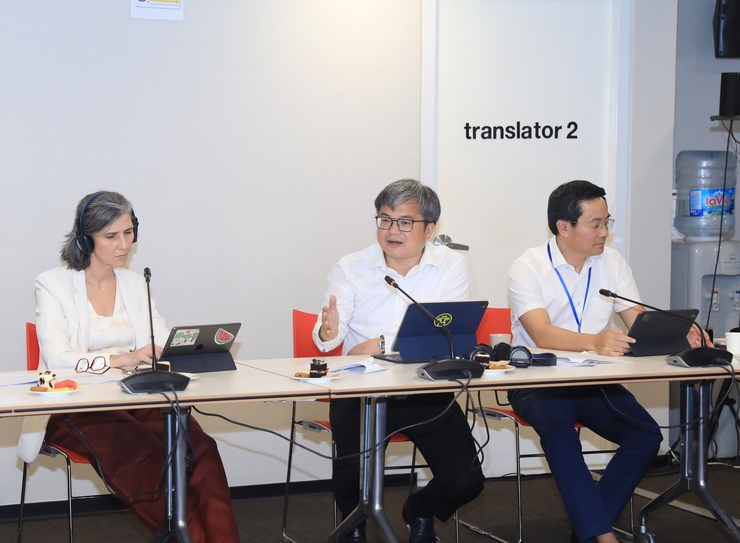
Overview of the event.
The survey results showed that Hanoi achieved a score of 43.7747, a decrease of 0.1856 points from 2023. This placed the city 29th out of 63 provinces, earning it a mid- to high-tier classification. Among the six centrally governed cities (with the addition of Hue in 2024), Ha Noi ranked second.
Among the eight dimensions measured, the city achieved high scores in public service provision (7.5690) and administrative procedures (7.1232). Additional top-tier performance came in citizen participation at the grassroots level and electronic governance.
Regarding term objectives, Hanoi successfully met its targets and advanced from the lowest to the second tier since 2020. Despite these strengths, the report noted declines in public service and administrative procedure scores, along with persistently low scores in environmental governance, electronic governance, and accountability to citizens.
Acknowledging the findings, the delegation requested that UNDP help identify these shortcomings with detailed area-specific analysis. The delegation also asked UNDP to assign experts to support Hanoi through intensive training in administrative reform and PAPI methodology.
The delegation stressed the need for practical, hands-on guidance for grassroots officials, representative survey sampling, question refinement suited to urban contexts, and forums for sharing best practices, especially in environmental governance and public service delivery.
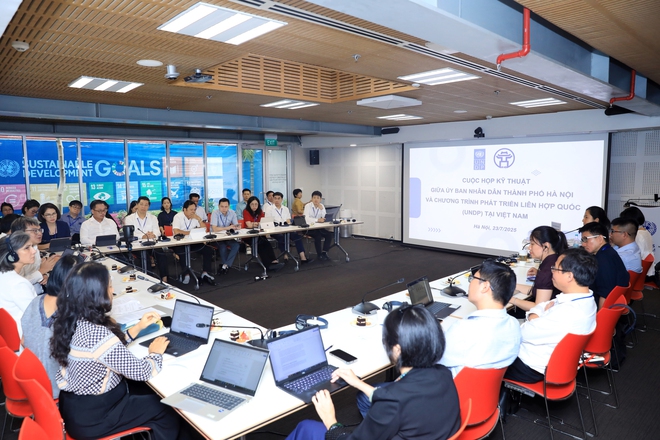
Overview of the event.
UNDP experts responded by highlighting weaknesses in environmental management (air and water quality), transparency (land‑use planning, land pricing, local budget disclosure), administrative procedure implementation, public service delivery, and citizen engagement. They offered a range of targeted recommendations.
At the conclusion, Dung emphasized that the meeting offered a valuable opportunity to review Hanoi's PAPI results, identify underlying issues, and develop concrete solutions to enhance service delivery for residents and businesses.
Dung also reaffirmed that improving governance and public administration remains a central, ongoing priority for Hanoi's development. Over recent years, the city has vigorously implemented synchronized reforms, from institutional restructuring and administrative procedure overhaul (including one‑door and integrated service mechanisms) to organizational restructuring, civil service reform, public finance reform, and the implementation of e‑government and digital governance.
The city also strengthened dialogue with citizens, expanded feedback channels, increased information transparency, enhanced accountability, and continuously improved public services—particularly administrative procedures.
However, Dung admitted that some PAPI indicators still fall short of expectations. "We take this very seriously," he said. "We sincerely welcome UNDP's and experts' feedback to adjust our policies and implementation methods to better fit reality."
He expressed gratitude to the experts for their insights and expressed hope for continued technical support, experience sharing, and collaboration in data analysis and strategy development to improve PAPI outcomes in Hanoi.
Dung concluded, "Hanoi commits to fully embracing all recommendations, coordinating closely on surveys, analysis, monitoring, and evaluation, and taking decisive actions to foster meaningful transformation toward a service-oriented, transparent, modern, and sustainable administration for the capital."