Through every circumstance, generations of officials and Party members in Hanoi have remained steadfast in their political will and commitment to the Party's ideals of "national independence associated with socialism."
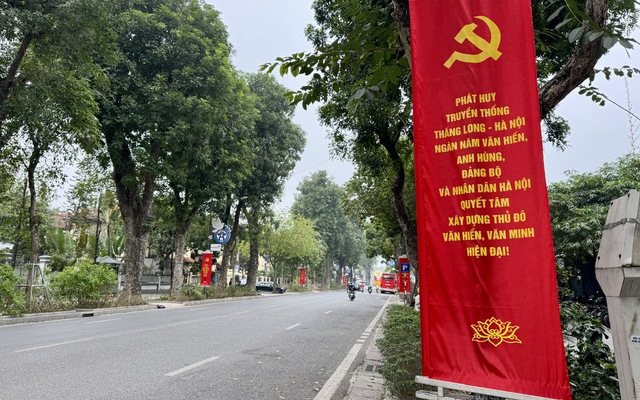
A corner of Hanoi.
They have maintained absolute faith in the Party's ideology, principles, resolutions, and policies, as well as in the State's laws, and in the inevitable success of Vietnam's revolutionary cause under the Party's leadership.
Together with the congresses of the former provincial Party Committees of Ha Dong, Son Tay, and Ha Son Binh, each congress of the Hanoi Party Committee has marked a historic milestone, reflecting major progress in Party building and the revolutionary movements of each era.
Hanoi takes pride in being one of the cradles of the revolution — home to Vietnam's first Party cell (5D Ham Long) and also the earliest established Party Committee in the country. On March 17, 1930, just over 40 days after the Communist Party of Vietnam was founded, the Provisional Executive Committee of the Hanoi Party Committee was formed at 42 Hang Thiec Street, then the headquarters of the Tonkin Party Committee and the Hanoi branch of the Indochinese Communist Party.
Its three founding members were Do Ngoc Du (Secretary), Nguyen Ngoc Vu, and Leu Tho Nam, marking a milestone in the revolutionary history of the capital.
With wisdom, determination, and creativity, the Hanoi Party Committee translated the directives of the Central Party and President Ho Chi Minh into concrete action. Through perseverance, sacrifice, and close unity with the people, it led many historic achievements, including the successful August Revolution in 1945, which established the Democratic Republic of Vietnam, and the victory at Dien Bien Phu on May 7, 1954, which "resounded across the five continents and shook the world."
On October 10, 1954, Hanoi was liberated, welcoming back the victorious army and reclaiming its role as the nation's political center. The Party Committee then guided the people to complete the national democratic revolution and begin building socialism between 1954 and 1958.
Due to its special position, Hanoi received direct guidance from the Central Party during its early decades. For nearly 30 years after its founding, the City Party Committee implemented the Party's revolutionary line through plenary conferences instead of formal congresses.
From April 21 to 30, 1959, the Hanoi Party Committee held a plenary conference at the Hanoi Opera House. Since then, it has convened 17 congresses, each a major political event marking an important stage in the Party's and the capital's development, truly a festival of unity for all Party members and citizens of Hanoi.
The Exemplary Party Committee
The First Congress
The Hanoi Party Committee held its first plenary conference at the Hanoi Opera House from April 21 to 30, 1959. According to the Central Party's instruction, the event was considered the First Congress of the Hanoi Party Committee. It gathered 236 delegates representing more than 12,000 Party members of the capital.
At that time, Hanoi had completed land reform in its suburban areas and was working to restore the economy and cultural life while rebuilding the capital in all aspects. These efforts contributed to strengthening the North and advancing the struggle for national reunification.
On April 25, 1959, the Congress was honored to welcome President Ho Chi Minh, who advised: "Wherever they are and whatever they do, Party members and Youth Union members must set an example. The Hanoi Party Committee must be a model for others. A model Hanoi Party Committee will help lead the North toward socialism and strengthen the foundation for national reunification."
The Congress set out key goals for 1959–1960, focusing on socialist transformation — the Party Committee's central mission — particularly in transforming private capitalist trade and industry into socialist enterprises. It also aimed to expand state-owned industries, mobilize the masses to improve enterprise management, accelerate industrial, agricultural, and infrastructure development, and strengthen transport networks. On this basis, it promoted cultural and educational advancement, improved living standards, consolidated the people's democratic administration, fulfilled national defense duties, and maintained public order.
The Second Congress
The Second Congress of the Hanoi Party Committee was held from January 25 to February 2, 1961. It marked an important turning point, initiating the first Five-Year Plan in the capital. The event brought together 310 delegates representing more than 20,000 Party members, determined to transform Hanoi from a consumer city into a productive, industrialized socialist city.
The Congress recognized that the greatest success of the previous term was the city's transformation across political, economic, and cultural spheres. Hanoi had shed its former image as a consumer city and emerged as a growing industrial center with mechanical, textile, and processing industries.
The Congress outlined key tasks for 1961–1962, emphasizing the acceleration of industrial and agricultural production, continued socialist transformation, and comprehensive city planning. It also called for improvements in education, management, and technical skills, and for enhanced living standards for the people.
The overarching goal was to build Hanoi into a socialist capital and an industrial hub contributing to socialist construction in the North and the cause of national reunification.
On February 1, 1961, President Ho Chi Minh attended the Congress for the second time and reminded delegates: "The Party Committee and the people of the capital, especially Hanoi's workers, must be exemplary, leading the entire North to victory."
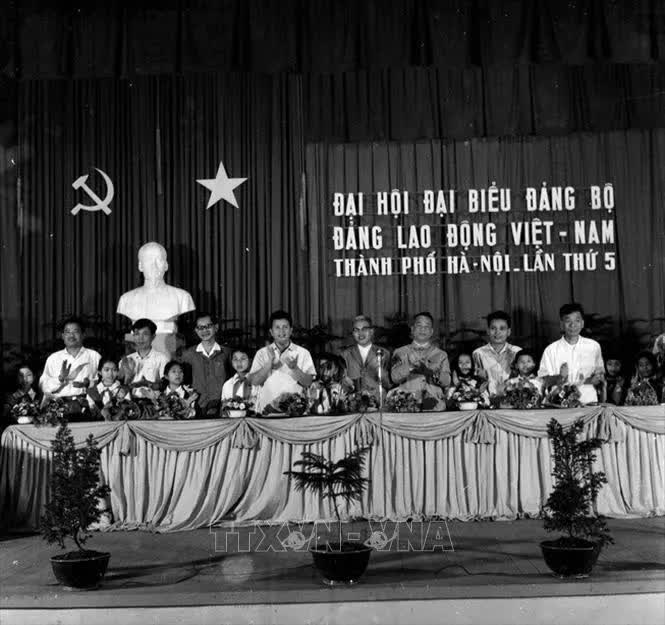
Overview of the Fifth Congress.
The Third Congress
In 1963, the Third Congress of the Hanoi Party Committee was held at the Hanoi Opera House from July 1 to 8, gathering 240 delegates representing 65,000 Party members. The Congress outlined key measures to advance economic development and further consolidate socialist relations of production.
The report presented at the Congress reviewed the first two years of the initial Five-Year Plan (1961–1965), noting that the city had made significant achievements in advancing socialist industrialization, strengthening state-owned enterprises, and building a material foundation for key economic sectors. It also highlighted progress in consolidating new production relations within agricultural and handicraft cooperatives, joint public–private enterprises, and in promoting ideological and cultural transformation, alongside improvements in living conditions.
The Congress identified the Party Committee's primary task as strengthening the material and technical foundations of the economy to further industrialize along socialist lines. It emphasized completing the socialist transformation process, improving production relations, enhancing the material and spiritual well-being of the people, and building Hanoi into a socialist capital that would strengthen the North and support national reunification.
The Fourth Congress
The Fourth Congress of the Hanoi Party Committee was solemnly convened at the Labor Club (now the Hanoi Youth Cultural Palace) from April 8 to 13, 1968, with 312 official delegates and 19 alternates representing more than 52,000 Party members. Its theme was "Promoting democracy, advancing the revolutionary offensive spirit, and striving for the greatest victory in the cause of national salvation and socialist construction."
The report to the Congress comprehensively reviewed the city's progress during four years of implementing the Third Congress Resolution (1964–1967), highlighting achievements in production, combat readiness, and public life. It set new goals for the emulation movements in production and combat for 1968–1969, calling on Hanoi to both fight alongside the nation against foreign aggression and continue building socialism.
The Congress emphasized the vigorous implementation of the three revolutions—scientific and technological, ideological, and cultural—and the cultivation of the new socialist citizen, embodying the character and spirit of the capital's people.
The Fifth Congress
From April 19 to 23, 1971, the Fifth Congress of the Hanoi Party Committee (1971–1974 term) was held at the Labor Club, now the Hanoi Youth Cultural Palace. It brought together 430 official and 30 alternate delegates representing more than 61,000 Party members across the capital.
The Congress concluded that during the three years from 1968 to 1970, Hanoi had successfully fulfilled its mission in the resistance against the United States, meeting all front-line demands while maintaining a strong rear and promptly reorganizing production and daily life. It set new directions for the next term, focusing on mobilizing the people to expand production, resist enemy bombings, and provide support to the southern front and the armed forces.
During this period, while Hanoi was striving for progress in every area, the United States launched its second wave of bombing against the North. The Party Committee of Hanoi led efforts to ensure the city's resilience and its ability to both fight and sustain life under wartime conditions.
The army and people of the capital defeated the enemy's strategic air campaign, contributing decisively to the historic victory known as the "Dien Bien Phu in the Air" after 12 nights and days in December 1972, which brought the anti-American resistance to final victory.
The Sixth Congress
From April 8 to 12, 1974, the Sixth Congress of the Hanoi Party Committee (1974–1977 term) was held at the Labor Club, now the Hanoi Youth Cultural Palace, with 516 delegates representing more than 64,000 Party members. The Congress took place in the year marking the 20th anniversary of the capital's liberation on October 10, 1974.
At a time when the anti-American resistance was entering a decisive phase, the Congress emphasized Hanoi's critical role and responsibility. It set forth key tasks to overcome wartime devastation, restore and develop the economy and culture, and accelerate socialist reconstruction across the city.
The Congress stressed comprehensive urban management and economic governance, reinforcement of socialist legality, and promotion of collective ownership and social discipline. It called for vigilance, effective military recruitment, and the strengthening of local defense, aiming to enhance the city's economic and defense potential and to improve the people's living standards.
Hanoi was determined to meet all manpower and material needs for the southern front, contributing to the historic liberation of the South and national reunification on April 30, 1975.
Implementing the Congress Resolution, Hanoi made significant contributions to the war effort, providing transportation, logistics, and human resources, both civilian and military. At the same time, the city ensured stable post-war recovery and maintained normal operations after liberation.
The Seventh Congress
The Seventh Congress of the Hanoi Party Committee (1977–1980 term) took place as Vietnam entered a new phase of socialist construction. The Congress was held in two sessions at the Labor Club.
The first session, from November 12 to 22, 1976, focused on discussing and contributing to the documents of the Fourth National Party Congress, reviewing the city's development plans for 1977, and electing Hanoi's delegation to the national congress.
The second session, held from May 25 to June 2, 1977, brought together 639 delegates representing nearly 70,000 Party members. The Congress adopted the Five-Year Plan (1976–1980), setting objectives for 1977–1978, including the gradual formation of an economic structure befitting the capital's potential and position. It also launched three major movements: "Production and Thrift," "Building the Capital," and "Promoting Civilized Lifestyles and Cultural Families."
During this term, at the fourth session of the Sixth National Assembly in December 1978, the Assembly approved the expansion of Hanoi's administrative boundaries. The capital incorporated five districts and one town from Ha Son Binh Province (Ba Vi, Thach That, Phuc Tho, Dan Phuong, Hoai Duc, and Son Tay Town) and two districts from Vinh Phu Province (Me Linh and Soc Son). By that time, Hanoi had 11 districts, one town, and four urban zones, with a total population approaching 2.5 million.
The Eight Congress
The Eighth Congress of the Hanoi Party Committee (1980–1983 term) was held at the Labor Club, now the Hanoi Youth Cultural Palace, from February 5 to 10, 1980, with 691 delegates representing nearly 140,000 Party members.
The Congress defined its core mission for 1980–1981 as simultaneously advancing three revolutions while building the socialist capital and ensuring national defense. Its immediate goals were to expand production, stabilize living conditions, strengthen the material and technical base of socialism, and improve economic and social management as well as Party organization and cadre development.
A defining achievement of this term was the implementation of Secretariat Directive No. 100-CT/TU on January 13, 1981, which reformed production contracting, extending output-based contracts to small labor groups and individuals within agricultural cooperatives. This policy revitalized the rural economy and trade. By mid-1983, the contracting mechanism had generated clear progress—farmers became more motivated, living conditions stabilized and improved, and food production rose by 8% annually. Many industrial enterprises also operated more efficiently and met their production targets.
The Ninth Congress
The Ninth Congress of the Hanoi Party Committee was held in two sessions in January 1982 and June 1983. The first session, from January 11 to 16, 1982, gathered 704 delegates to discuss Central Party documents and elect Hanoi's delegation to the Fifth National Party Congress. The second session, from June 11 to 16, 1983, brought together 622 delegates representing over 130,000 Party members to define the city's development priorities for 1983–1985.
During this period, Hanoi pursued four key socio-economic objectives to gradually strengthen and defend the capital. The main priorities were to address urgent livelihood needs, restore and develop infrastructure, boost production capacity, and restore economic and social order, particularly in distribution and trade. The Party Committee also led efforts to counter enemy sabotage, safeguard political stability, and maintain social order.
By the end of this term, marking a decade since national reunification (1975–1985), Hanoi had achieved substantial progress across all sectors. The capital's experience and accomplishments during this period laid the groundwork for accelerated development in the years that followed.
The 10th Congress (1986–1991)
Held from October 17 to 23, 1986, the 10th Congress marked the beginning of the Doi Moi (Renewal) reform era in Hanoi. It launched the transition from a centrally planned, bureaucratic economy to a socialist market-oriented system based on business accounting principles.
The Congress focused on stabilizing socio-economic conditions, ensuring adequate supply of goods, energy, and materials, and restoring public order. These reforms revitalized the city's economy, improved living standards, and established political and social stability.
The 11th Congress (1991–1996)
Held in two sessions—April and November 1991—the 11th Congress assessed the early success of Doi Moi. Hanoi had largely abolished the subsidy system and begun forming a multi-sector commodity economy under state management.
The Congress aimed to stabilize and grow the economy, create 40,000 jobs annually, and raise GDP growth to 6–7% per year. During this period, Hanoi's economic structure diversified, and urban development accelerated.
The 12th Congress (1996–2000)
Held from May 7 to 9, 1996, this Congress took place after a decade of Doi Moi, as Hanoi's economy strengthened significantly. It set five overarching goals, emphasizing rapid economic growth and industrialization while preserving socialist principles and improving urban planning and infrastructure.
The city targeted an average annual growth rate of 15% and per capita income of about US$1,100 by 2000. In 1999, UNESCO honored Hanoi as a "City for Peace," and in 2000, the Party and State awarded it the title of "Heroic Capital."
The 13th Congress (2000–2005)
Held from December 27 to 30, 2000, shortly after the 990th anniversary of Thang Long–Hanoi, this Congress set the long-term vision for the millennium celebration in 2010. It focused on comprehensive, sustainable development across economic, cultural, scientific, and social sectors.
Hanoi aimed to build a modern, cultured, and civilized socialist capital with strong material and social foundations, ready to enter the knowledge economy. The city also advanced major urban and infrastructure projects during this term.
The 14th Congress (2005–2010)
Held from December 21 to 23, 2005, with the theme "Promoting the Capital's Tradition and Achievements for Comprehensive and Sustainable Development," the Congress reaffirmed Hanoi's modernization goals.
A historic milestone came on August 1, 2008, when the National Assembly approved Resolution No. 15/2008/QH12 to expand Hanoi's administrative boundaries, merging it with Ha Tay Province and parts of Vinh Phuc and Hoa Binh. By 2008, the enlarged Hanoi covered over 3,324 km² with more than six million residents.
By the end of the term, the city's GDP had grown 6.4 times compared to 1985, and export turnover 47 times, marking two decades of successful Doi Moi.
The 15th Congress (2010–2015)
Held from October 25 to 28, 2010, the first Congress after the city's expansion took place shortly after the 1,000th anniversary of Thang Long–Hanoi. It set the theme of promoting unity and innovation to build a modern, prosperous, and civilized capital.
The Congress reported strong economic growth, with structural shifts toward services and industry. It established key targets, including annual GDP growth of 12–13% and export growth of 14–15%. Nine key programs and two breakthrough initiatives guided comprehensive progress in urban management, cultural development, and rural modernization.
The 16th Congress (2015–2020)
Held from October 31 to November 3, 2015, with 495 delegates, the Congress focused on building a clean, strong Party organization and achieving socio-economic breakthroughs. Sixteen specific targets were set, including an average annual GRDP growth of 8.5–9%.
The Congress outlined five main tasks and three strategic breakthroughs: modernizing urban and rural infrastructure, advancing administrative reform, and improving human resources. By 2020, Hanoi had met or exceeded all 16 targets, achieving notable progress in new rural development, education, and poverty reduction.
The 17th Congress (2020–2025)
Held from October 11 to 13, 2020, with 497 delegates, the Congress set a vision to make Hanoi a green, smart, modern city with high competitiveness by 2025. It approved five strategic orientations, three breakthroughs, and 14 key task groups.
Despite the COVID-19 pandemic, Hanoi achieved strong recovery, with average growth of 6.57%, exceeding the national rate. The city completed its urban–rural modernization programs, ensured social welfare, and eliminated poverty under city standards by 2024. Major infrastructure projects and environmental restoration initiatives, including To Lich River cleanup, marked this period.
The 18th Congress (2025–2030)
Held from October 15 to 17, 2025, the 18th Congress adopted the theme "Upholding the Millennial Tradition of a Heroic and Cultured Capital; Building a Strong, Pioneering Party; Advancing into the New Era."
The Congress represents a pivotal political event as Hanoi and the nation enter a new era of opportunities and challenges. It aims to consolidate leadership capacity, accelerate modernization, and develop Hanoi into a prosperous, happy, and globally connected metropolis.