During the 2021–2025 term, the Party Committee of the Department of Industry and Trade consistently took the initiative and actively renewed its leadership methods, strictly adhered to the principle of democratic centralism in leadership, direction, and administration.
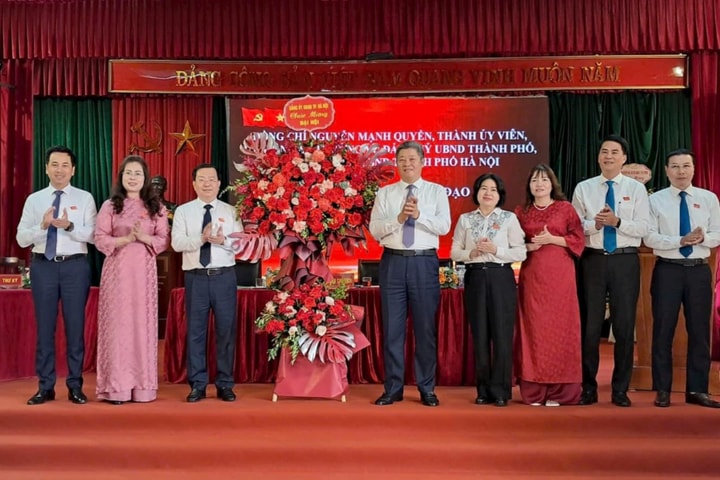
Overview of the congress.
The Party Committee of the Department has surpassed many of the goals set for the 2021–2025 term, according to updated projections.
By the end of 2025, the added value of the industrial sector is expected to grow by around 7 percent, with an average annual increase of approximately 5.94 percent during the five-year period. The industry–construction sector is projected to contribute 22.5 to 23 percent to the Gross Regional Domestic Product (GRDP), while the processing and manufacturing industries will account for roughly 17 percent.
Retail sales of goods and revenue from consumer services are on track to grow by about 10 percent annually. Export turnover is also projected to rise at an average annual rate of 5.1 percent, reaching approximately US$19.4 billion by the end of the term.
Notably, the target of equipping 100 percent of industrial clusters and craft village industrial zones with wastewater treatment stations by 2025 has already been met.
In recent years, the Department of Industry and Trade has promoted administrative reform and closely coordinated with other departments, sectors, and district-level People's Committees to resolve difficulties, support, and promote the development of industrial, commercial, and energy infrastructure in the area. As a result, domestic enterprises have effectively taken advantage of next-generation free trade agreements.
In implementing Party-building work during the 2020–2025 term, the Department of Industry and Trade organized and fully developed implementation plans for the Resolutions of the Party Congress at all levels. During this term, the Department sent 19 members to attend Party awareness training courses, 16 members to new Party member training, and admitted 15 new Party members, surpassing the target of 10 members by 50 percent.
Building upon these achievements, for the 2025–2030 term, the Party Executive Committee of the Department of Industry and Trade will focus on successfully fulfilling the sector's political tasks, contributing to maintaining economic stability, controlling inflation, while accelerating growth and ensuring sustainable economic development.
The Department will establish, consolidate, and develop commodity distribution channels in a modern, civilized, and sustainable direction. It will promote the development of modern distribution types and the implementation of e-commerce, along with enhancing cashless payment methods.
The Party Committee of the Hanoi Department of Industry and Trade has set high development goals for the 2026–2030 period, aiming to sustain strong growth across key economic sectors while enhancing Party-building efforts.
For the industrial sector, the added value is projected to grow by 13.2 to 14.2 percent annually. Total retail sales of goods and consumer service revenue are expected to increase by 14.45 to 16.48 percent per year, while export turnover is targeted to rise by 11.9 to 14 percent annually.
In terms of Party-building, starting in 2025, the Party Committee and grassroots Party organizations will implement regulations, work plans, and inspection and supervision programs for the 2025–2030 term. All Party members, Youth Union members, and affiliated association members will register to study and follow Ho Chi Minh’s ideology, morality, and lifestyle—integrated with efforts to overcome individual and collective shortcomings identified in annual reviews.
Each Party branch will hold at least four thematic meetings per year and aim to earn the title of a “clean and strong” or “exemplary clean and strong” Party Committee. Additionally, 100 percent of subordinate agencies and units are expected to fulfill their assigned political tasks with excellence.
To achieve these goals, in the next term, the Hanoi Department of Industry and Trade will continue administrative reform. The department will accelerate the development and implementation of plans to improve the Public Administration Reform Index and the Satisfaction Index of People and Organizations regarding the service of the City's and Department's administrative agencies.
The department will continue reorganizing its apparatus towards streamlining and reassess, rearrange civil servants, public employees, and workers to match job positions and the actual conditions of the Department.
The Hanoi Department of Industry and Trade will prioritize planning and strategic development as a foundation for guiding development orientation across all levels, sectors, and businesses. These plans will support the selection of investment projects and the formulation of long-term development strategies.
To facilitate transparency and investor engagement, the department will publicly announce and regularly update planning information through mass media channels. This aims to attract both domestic and international enterprises to take advantage of preferential policies and invest in the city’s key projects.
In addition, the department will focus on establishing, consolidating, and expanding commodity distribution networks in a direction that is modern, civilized, and sustainable.
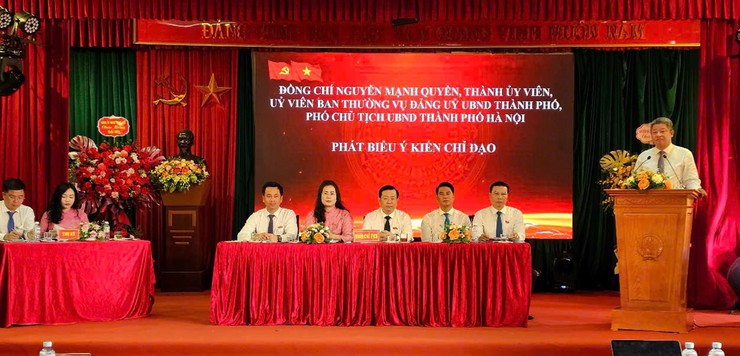
Overview of the congress.
Delivering a directive speech at the Congress, Vice Chairman of the Hanoi People’s Committee Nguyen Manh Quyen emphasized the critical role of the Party Committee of the Department of Industry and Trade in supporting the city’s development goals.
He urged the department to fully leverage its advisory role by proposing practical policies and mechanisms to help the municipal government manage the industry and trade sectors more effectively. Such guidance, he noted, is essential for positioning Hanoi as a national hub for high-tech industries.
Quyen also stressed that investment attraction should prioritize environmentally friendly industries, aligning with sustainable development goals. In the commercial sector, he called for the renovation and modernization of the city’s traditional market system, alongside the development of modern retail infrastructure, such as supermarkets and outlet centers, to support local producers in distributing goods and to ensure consumers have access to authentic products at affordable prices.
The market management force, besides strengthening market inspection and control, must also enhance communication of legal regulations to citizens, businesses, and production households to limit the prevalence of counterfeit, imitation, and substandard goods. Particularly, the Hanoi industry and trade sector must clearly assign responsibilities to units in charge of specific areas; if there are violations such as counterfeit goods, smuggling, or food safety breaches in any locality, the head of that locality must be held accountable.
Hanoi is developing a modern industrial system, which consumes a large amount of electricity. Therefore, the power sector must focus on developing a modern power grid system to meet the production and business needs of enterprises.
At the Congress, with the spirit "A united and creative Party Committee – Building a civilized and modern Capital Industry and Trade sector," the delegates elected 13 members to the 21st Party Executive Committee of the Department of Industry and Trade for the 2025–2030 term and elected the delegation to attend the first Party Congress of the Hanoi People's Committee.