Hanoi is not only the nation's center but also a pioneer leading the path of renewal, where the aspiration for a strong, prosperous, and happy Vietnam originates.
In that spirit, the 18th Congress of the Hanoi Party Committee is a major political event for the Party, government, armed forces, and people of the capital.
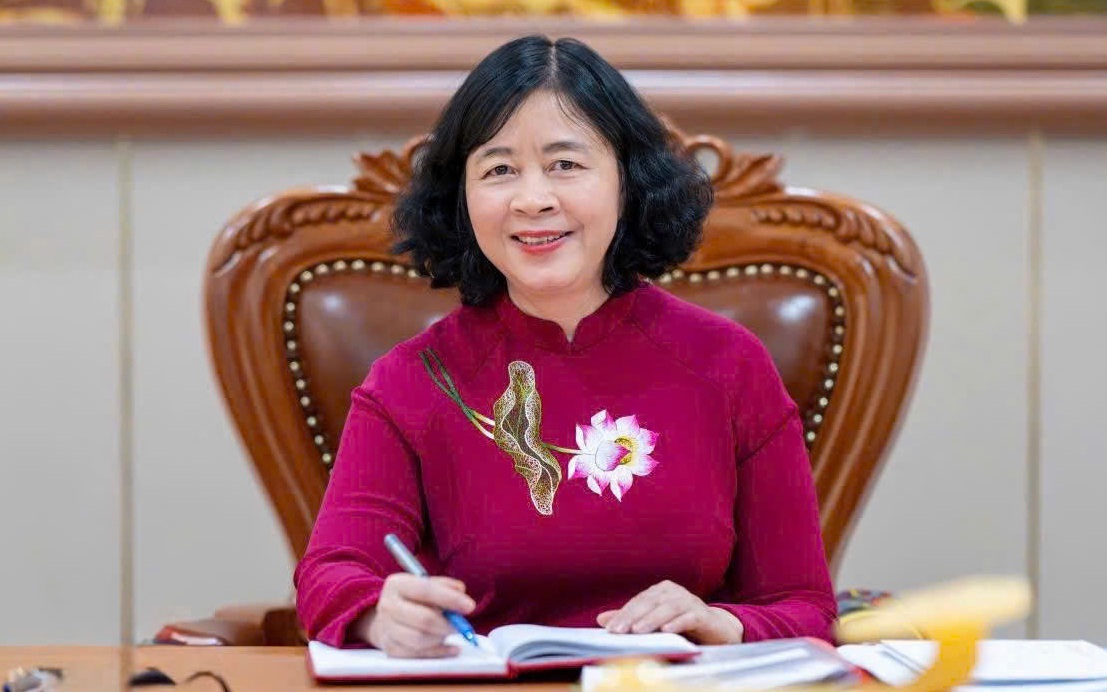
Secretary of the Hanoi Party Committee Bui Thi Minh Hoai.
With the motto "Solidarity – Democracy – Discipline – Breakthrough – Development," the Congress is determined to uphold the thousand-year-old tradition of heroism and culture, build a clean and strong Party, lead with creativity in the new era, and develop a civilized, modern, and happy capital, contributing to the successful realization of the nation's centennial goals.
Creating Momentum and Strength for a New Era
Eighty years after the country's independence in 1945, seventy-one years since the Liberation of the Capital on October 10, 1954, and nearly forty years since the start of Doi Moi in 1986, Hanoi has persisted under the leadership of the Party to grow as the nation's political and administrative center, the heart of Vietnam, and a hub for economics, culture, education, science, technology, and international integration. During this proud journey, the 17th Congress made significant contributions.
Facing challenges beyond expectation, the Party, government, armed forces, and people of Hanoi united with determination and creativity to implement the 17th Congress Resolution with 10 work programs, 5 key tasks, and 3 breakthroughs.
The city achieved comprehensive results, completing 16 of 20 major targets, with 4 surpassing the plan ahead of schedule, creating a strong foundation for the capital to move forward confidently into a new era of national growth.
Building a clean and strong Party is the foundation of public trust, as the capital's strength stems from the unity between the people and the Party. During the term, Party-building and political system reforms were implemented creatively in line with the city's specific context.
Political and ideological work emphasized integrity and accountability. Mass mobilization efforts were renewed through thousands of effective "smart outreach" models, reflecting the principle that "the people are the root."
Cadre management reforms introduced a data-based approach, focusing on matching people to tasks and measuring performance by results and citizen satisfaction. Hanoi exceeded targets for new Party members and led the nation in recruiting young students and intellectuals—the future leaders of the country.
Oversight and discipline were strengthened, with swift, transparent handling of complex cases assigned by the Central Committee. Anti-corruption efforts remained continuous and uncompromising, ensuring no tolerance zones or exceptions.
By August 22, 2025, Hanoi had completed Party congresses in all 136 organizations for the 2025–2030 term, surpassing the schedule.
Leadership methods continued to evolve. Bold in vision and decisive in action, Hanoi's leaders advanced policies to improve citizens' wellbeing.
The city contributed practical proposals that led to major national decisions, including Politburo Resolution No. 15-NQ/TW on May 5, 2022, outlining directions for Hanoi's development to 2030 with a vision to 2045; the Capital Law adopted in 2024; the Hanoi Capital Planning for 2021–2030 with a vision to 2050; and the Comprehensive Adjustment of the Capital's Master Plan to 2045 with a vision to 2065.
Today, developing the capital is not only about building a city but also about shaping the nation's stature and expressing Vietnam's aspirations in the new era.
Hanoi took the lead in restructuring its administrative units, reducing from 526 to 126, with more than 97% citizen approval. The city's economy grew robustly, with an average GRDP growth rate of 6.57% per year—1.1 times higher than the national rate.
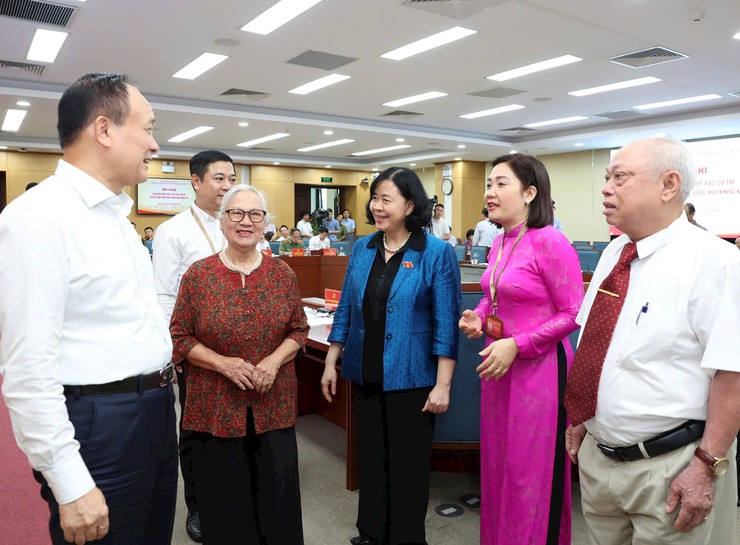
Hanoi leaders during a meeting with voters.
Its economic scale reached about $63 billion, 1.42 times higher than in 2020, accounting for 41.54% of the Red River Delta and 12.6% of the national economy. Per capita GRDP reached US$7,200. Hanoi completed its new rural development program two years ahead of schedule, leading the nation in advanced and model rural initiatives.
Urban infrastructure continued to improve, with progress in transport and social facilities. The city launched the Ring Road 4 project, operated two urban rail lines (Cat Linh–Ha Dong and Nhon–Hanoi Station elevated section), began construction of Line 2 (Nam Thang Long–Tran Hung Dao), and broke ground on five Red River bridges: Tu Lien, Ngoc Hoi, Van Phuc, Thuong Cat, and Tran Hung Dao. Hanoi also inaugurated Southeast Asia's largest exhibition center and began work on the Ngoc Trai Theatre.
Hanoi's breakthroughs lie not in project scale but in institutional vision, governance capacity, and human creativity.
The city leads the nation in information technology, digital governance, and innovation indices. Cultural and social development remain strong. In 2025, Time Out magazine named Hanoi one of the world's leading cultural destinations.
The city has invested heavily in preserving cultural and historical sites, maintaining top national rankings in healthcare and education, and completely eliminating poverty under multidimensional standards by 2024.
Reflecting its people-centered approach, Hanoi now has the highest Human Development Index in Vietnam at 0.829 and an average life expectancy of 76.5 years, up by one year since 2020. Following the directives of the Central Committee and General Secretary To Lam, Hanoi became the first locality nationwide to provide subsidized lunches for primary school students starting in the 2025–2026 academic year. The city has also demonstrated resilience in disaster and epidemic response, notably during the COVID-19 pandemic and Typhoon Yagi in 2024.
Hanoi continues to prioritize environmental protection, expanding parks and green spaces and addressing waste management through two waste-to-energy plants. Its determined and coordinated actions have gradually revived the To Lich River.
With the police and military as core forces, Hanoi remains one of the safest and most secure cities in the country while pioneering administrative reform through a single-tier Public Service Center model that enhances transparency and investor confidence.
Hanoi today embodies the harmony of tradition and modernity—cultured, compassionate, and forward-looking. The grand celebrations marking the 80th anniversary of the August Revolution and National Day created a nationwide atmosphere of pride and inspiration.
Building a Cultured, Civilized, and Modern Capital
As Hanoi enters a new stage of development, it faces both opportunities and challenges, including urban congestion, aging population, climate change, natural disasters, and the four risks identified by the Party: stagnation, corruption, "peaceful evolution," and "self-transformation."
On August 21, during a Politburo meeting with the Hanoi Party Committee, General Secretary To Lam emphasized the vision of building a green, smart, livable, and globally attractive capital.
Following this direction, Hanoi has implemented seven strategic Politburo resolutions to achieve by 2030 a cultured, civilized, and modern capital—green, smart, and globally integrated, with competitiveness on par with regional capitals.
It aims to be a major economic and financial hub, a leading center of culture, education, healthcare, science, and innovation, with a peaceful society and happy citizens.
Looking ahead to 2045, Hanoi aspires to become a globally connected city with high living standards and a balanced, distinctive economy, culture, and society comparable to leading world capitals. Per capita GRDP is projected to exceed $36,000.
To realize this vision, the city has set 43 targets for 2030 in economic, social, urban, environmental, and Party-building areas. It aims for annual GRDP growth of at least 11%, per capita GRDP above $12,000, the digital economy accounting for 40% of GRDP, and cultural industries for about 8%.
Total social investment will reach VND5 quadrillion ($197.5 billion). The Human Development Index will reach 0.88, the Happiness Index 9/10, and at least 80% of the workforce will be trained. Each year, at least 11,000 new Party members will be admitted, and over 90% of Party organizations and members will fulfill their duties.
Guided by the spirit of "new vision, global thinking, and decisive Hanoi action," the Political Report to the 18th Congress identifies 10 key missions and three breakthrough priorities. The city is committed to leading efforts to build a streamlined, transparent, and effective government that truly serves the people.
Priority will be given to implementing the Capital Law, reforming mechanisms to remove obstacles, mobilizing resources, and piloting innovative policies in science, technology, private-sector development, education, healthcare, and digital transformation. Decentralization and delegation will be advanced under the principle "local decision, local responsibility."
Hanoi will also focus on developing high-quality human resources and attracting talent, particularly among leaders and managers who possess vision, integrity, and dedication. Mechanisms will be introduced to protect and reward officials who innovate for the common good, while attracting outstanding experts and professionals from both domestic and international sectors.
At the same time, the city will prioritize developing a modern, smart, and connected infrastructure system. Investments will focus on integrated transportation networks linking urban centers with surrounding regions, including expressways, national highways, ring roads, bridges across the Red and Duong Rivers, urban railways, and logistics corridors.
Transit-oriented urban planning (TOD), underground space development, and digital and scientific infrastructure will create the foundation for sustainable growth and enhanced competitiveness in the digital era.
With its pioneering role in the new era of national renewal, Hanoi is determined to realize its vision of becoming a cultured, globally connected, elegant, and prosperous capital, led by a service-oriented government, supported by a dedicated business community, and trusted by its people.
Every resolution will be accompanied by concrete action plans with clearly assigned responsibilities and timelines, adhering to the "six clarity" principle: clear people, clear tasks, clear time, clear responsibility, clear results, and clear authority.
Every step forward for Hanoi reinforces national confidence and showcases Vietnam's strength and intellect on the global stage. From Thang Long of a thousand years ago to today's Hanoi, the same enduring spirit remains—daring to think, daring to act, and daring to take responsibility for the people's interests.
With the guidance of the Central Committee and General Secretary To Lam, and the unity and determination of the Party, government, and people, the 18th Congress of the Hanoi Party Committee for the 2025–2030 term will be a resounding success, opening a new chapter of growth and prosperity for both the capital and the nation.
Hanoi, the City for Peace and Creativity, will forever stand as a symbol of faith, aspiration, and courage in Vietnam's era of renewal. From the spirit of the 18th Congress, a new confidence is rising—belief in a modern Hanoi that preserves its grace, a dynamic capital deeply rooted in culture, and a globally integrated city that remains authentically Vietnamese. "Pioneer – Breakthrough – Development – Happiness" is not just a goal, but a solemn promise from today's Hanoi to future generations.