The event was an important forum for policy discussion and dialogue between state management agencies, experts, scientists, National Assembly deputies, the business community and media agencies. The dialogue aimed to clarify key contents of the draft revised Capital Law, especially special and breakthrough mechanisms and policies for the capital.
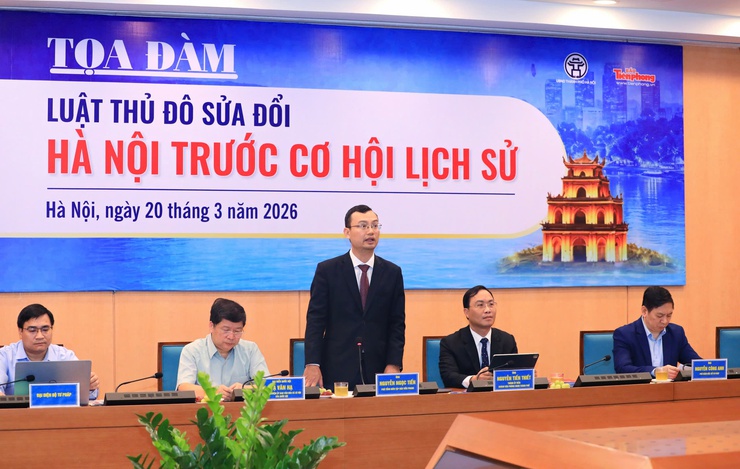 Tien Phong Newspaper Deputy Editor-in-Chief Nguyen Ngoc Tien speaks at the opening of the policy dialogue. Photo: Le Hai
In his opening remarks, Tien Phong Newspaper Deputy Editor-in-Chief Nguyen Ngoc Tien said the dialogue aimed to help readers gain a comprehensive understanding of the issues facing the capital's development, while discussing necessary special and breakthrough policy mechanisms for the next phase.
According to journalist Nguyen Ngoc Tien, Hanoi, as the national political and administrative center and the heart of the country, faces high development demands but also many challenges, including traffic congestion, air pollution, localized flooding and waste management. These issues require a strong and special legal framework suitable for a special urban area like Hanoi.
The revision of the Capital Law is not only intended to remove immediate bottlenecks but also to build a special, breakthrough and stable institutional framework with a long-term vision, appropriate to the capital's position and role.
"Through this, Hanoi can turn institutions and laws into a competitive advantage, creating room to sustain double-digit economic growth and make significant contributions to national development," Tien emphasized.
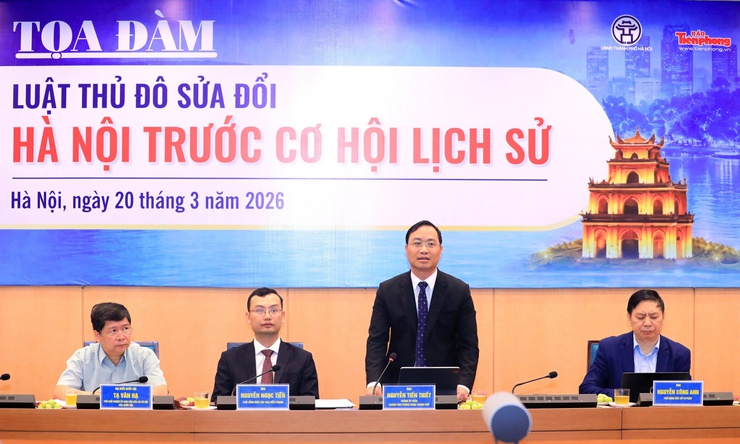 Nguyen Tien Thiet, Chief of the Office of the Hanoi People's Committee, delivers the keynote presentation at the policy dialogue. Photo: Le Hai
In his keynote remarks, Chief of Office of the Hanoi People's Committee Nguyen Tien Thiet said the central government had allowed Hanoi to simultaneously develop three particularly important documents: a Politburo resolution on building and developing Hanoi in the new era as the political foundation, the revised Capital Law as the legal foundation and the Hanoi Master Plan with a 100-year vision as the long-term development direction.
After preparation by central and city agencies, on March 17 the Politburo issued Resolution No. 02 on building and developing Hanoi in the new era, clearly defining long-term development requirements based on an open development space and a multi-layered, multi-centered urban model associated with the 100-year master plan.
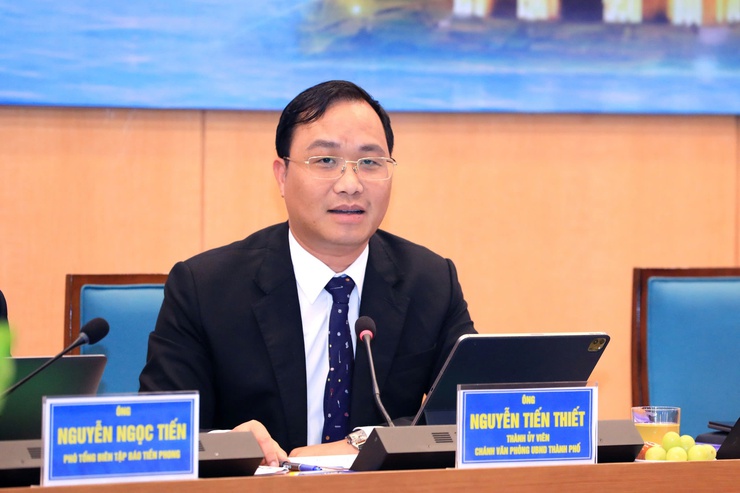 Nguyen Tien Thiet, Chief of the Office of the Hanoi People's Committee. Photo: Le Hai
Resolution No. 02 particularly emphasizes building special and breakthrough institutional mechanisms and strengthening decentralization and delegation of authority together with power control and accountability, ensuring the capital has sufficient authority, tools and resources to proactively make decisions and take full responsibility for development.
Thiet said the city is developing the Hanoi Master Plan with a 100-year vision, aiming to build Hanoi as a "Cultured – Civilized – Modern – Happy" city, green, smart and deeply integrated internationally, gradually becoming a major economic, financial, commercial and science and technology center of the country and the region.
To achieve these goals, Hanoi needs a strong and flexible legal framework that allows the city to be more proactive in governance, from urban government models, fiscal and budget mechanisms, planning and land management, infrastructure development, to attracting high-quality human resources and promoting innovation, thereby effectively leveraging internal resources instead of competing with other localities for external resources.
In recent years, Hanoi has achieved many development results but still faces major challenges, especially in urban management and development. Infrastructure pressure, traffic congestion, environmental issues, planning challenges and quality of life concerns are increasing, while some existing policies and mechanisms have not kept pace with the requirements of a special urban area.
From both political and practical perspectives, revising the Capital Law is not only urgent but also an objective requirement and a strategic step to improve policy design and upgrade the legal framework in line with the direction of the General Secretary.
This approach follows the principle of stronger authority, more comprehensive decentralization and clearer accountability, in line with the principle that Hanoi decides, Hanoi implements and Hanoi takes responsibility, ensuring sufficient institutional space to achieve continuous double-digit growth and fulfill the capital's long-term development vision and leadership role in the new context.
Based on this approach, Thiet proposed that representatives from state agencies, experts, scientists and National Assembly deputies focus discussions on several key issues:
First, whether the special mechanisms and policies in the draft law are sufficiently different and strong to create breakthroughs for the capital's development.
Second, how decentralization and delegation of authority should be designed to promote initiative and creativity while ensuring effective power control.
Third, how solutions for resource mobilization, infrastructure development, environmental protection and urban renovation should be specified to ensure feasibility.
Fourth, what mechanisms should allow Hanoi to open new development spaces in line with the 100-year master plan.
Fifth, how the revised Capital Law can truly become a tool to promote innovation, improve competitiveness and enhance quality of life for residents, in other words how the law can be implemented quickly and effectively in practice.
At the dialogue, National Assembly deputies including Ta Van Ha, Vice Chairman of the National Assembly Committee on Culture and Social Affairs, Phan Duc Hieu, Standing Member of the National Assembly Committee on Economic and Financial Affairs and Le Tuan Phong from the Ministry of Justice, along with representatives from Hanoi agencies, emphasized that revising the Capital Law is not only to address immediate bottlenecks but also to build a special, breakthrough and stable institutional framework with a long-term vision, appropriate to the capital's position, role and special characteristics.
Ha said this would allow Hanoi to turn institutions and laws into a competitive advantage, creating room for sustained double-digit economic growth and contributing significantly to national development.
The revision of the Capital Law aims to build a special and breakthrough institutional framework with a long-term vision, appropriate to the capital's role as a special urban area, the national political and administrative center, a major economic, cultural, science and technology and innovation center and a growth driver for the Red River Delta and the country. Turning institutions and laws into a competitive advantage and a strong development foundation to sustain double-digit economic growth is one of the key tasks the city is implementing in coordination with ministries and central agencies.
Delegates also discussed major issues of the draft revised Capital Law, including decentralization and delegation mechanisms, special policies on planning, construction and science and technology, resource mobilization for development, solutions to infrastructure, urban and environmental bottlenecks and ensuring consistency between the revised Capital Law and the long-term Hanoi Master Plan.