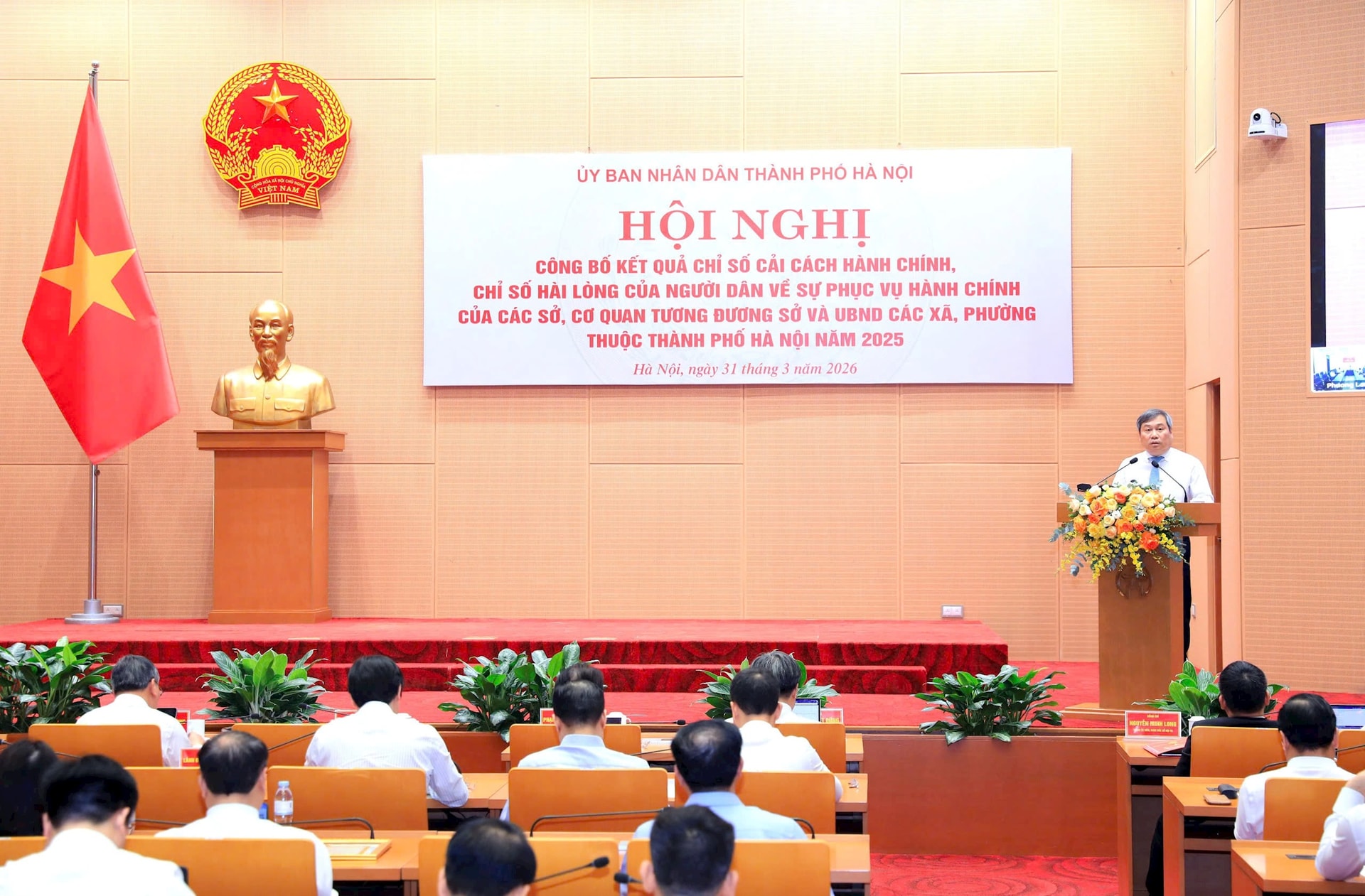
 Vu Dai Thang, Chairman of the Hanoi People's Committee, delivers remarks at the conference. Photo: Pham Linh
On the morning of March 31, the Hanoi People's Committee held a conference to announce the results of the 2025 Administrative Reform Index, or PAR Index, and the Satisfaction Index of Public Administrative Services, or SIPAS, for departments, department-level agencies, and the People's Committees of communes and wards across the city.
Administrative reform must become a driver of growth
Speaking at the conference, Vu Dai Thang, Member of the Party Central Committee, Deputy Secretary of the Hanoi Party Committee, and Chairman of the Hanoi People's Committee, praised the preparation work of the Department of Home Affairs, the Office of the Hanoi People's Committee, and related agencies and units. He also commended the appraisal council, the working group, and departments, sectors, and localities for implementing the 2025 PAR Index assessment in a way that ensured quality, progress, objectivity, and substance.
Thang affirmed that administrative reform continues to be identified by the city as one of its key and ongoing political tasks, one that is decisive for improving the effectiveness and efficiency of state management and the quality of services for residents and businesses, while also directly contributing to the capital's economic growth and socio-economic development.
According to the city chairman, in the new context, administrative reform cannot be carried out in isolation, but must be closely and synchronously linked with science and technology development, innovation, digital transformation, and the building of digital government, the digital economy, and digital society.
"The city has clearly defined its consistent guiding view: administrative reform is a driver of growth; residents and businesses are at the center of service delivery; satisfaction is the measure of effectiveness; and implementation results are an important basis for evaluating officials and civil servants, especially agency heads," Thang said.
The year 2025 was the first year Hanoi implemented the two-tier local government model. In that context, administrative reform achieved initial positive results, reflected in a more streamlined organizational structure that has operated in a basically stable manner, and a governance approach that has shifted toward a more modern, integrated, and results-centered model.
At the same time, the application of information technology and digital transformation in management, administration, and public service delivery continued to be expanded. Several reform models and initiatives were implemented effectively, helping improve service quality for residents and businesses.
Notably, the city has started applying artificial intelligence in government operations and has effectively operated the "Digital Capital Citizen – iHanoi" platform to strengthen interaction between authorities and residents. At the same time, it has renewed the method for evaluating officials and civil servants by quantifying performance through specific indicators.
The new method of determining the PAR Index by A, B, and C groups, linked to real-world data and monitored in real time, has helped improve transparency and objectivity while creating clearer pressure for each agency and unit to improve. At the same time, the city's Steering Committee for Science and Technology Development, Innovation, Digital Transformation, and Administrative Reform has begun to show its effectiveness as a coordinating body, helping the city deliver unified and timely direction.
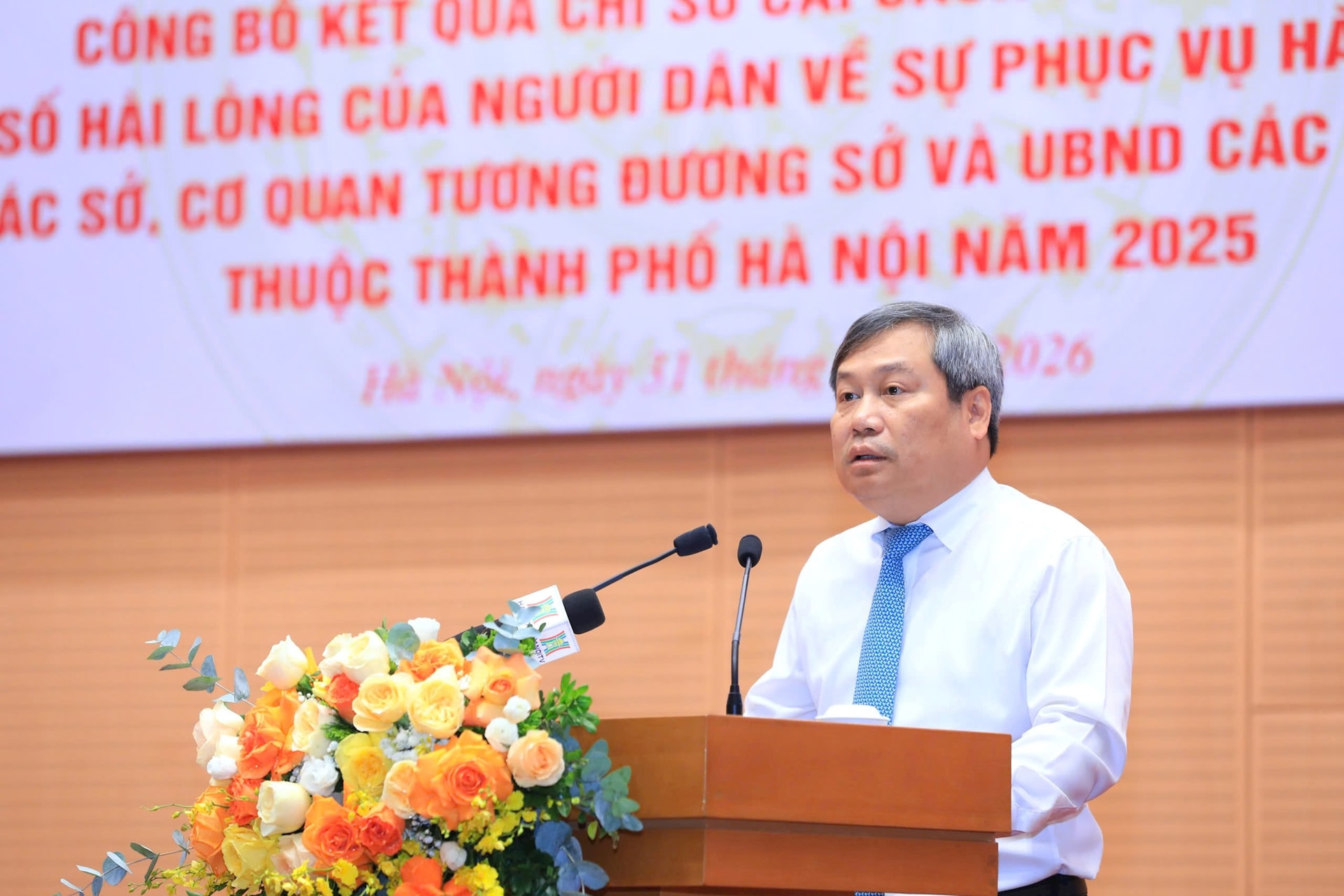 Vu Dai Thang, Chairman of the Hanoi People's Committee, delivers remarks at the conference. Photo: Le Hai
Alongside these results, the city chairman frankly acknowledged that administrative reform still faces several shortcomings and limitations. Among the most notable is that some agencies and units have not truly treated administrative reform as a key and breakthrough task.
Meanwhile, administrative discipline and order remain lax in some places. Avoidance of responsibility and the shifting of duties to others still occur. Delegation and decentralization have not been carried out in a synchronized or thorough way, and some reform initiatives and models have not been reviewed and expanded in a timely manner.
"For the shortcomings and limitations mentioned above, responsibility first and foremost lies directly with the heads of agencies and units," Thang stressed.
Focus on eight key groups of tasks in 2026
To ensure the city's administrative reform efforts become more substantive, more effective, and produce clearer changes in the coming period, Thang asked all levels and sectors to focus on eight key groups of tasks.
First, he said, the city must continue tightening administrative discipline and order, raise the role and responsibility of agency heads, and ensure every agency and unit acts proactively and decisively in leading and directing administrative reform.
At the same time, the city will closely link administrative reform results with the evaluation and classification of officials, civil servants, and public employees, as well as with emulation and reward programs, and will strictly deal with cases of avoidance, shirking responsibility, and causing inconvenience to residents and businesses.
 Hanoi is building a public administration system that is honest, disciplined, professional, and associated with modern governance and effective, efficient operations. Photo: Pham Linh
Second, agencies and units need to carry out reform in a substantive way across core areas, with particular emphasis on institutional reform and administrative procedure reform, especially internal administrative procedures.
At the same time, units must continue streamlining the organizational apparatus, improving the quality of officials and civil servants, renewing the civil service system based on results, and accelerating digital transformation and digital government building. Every task must have clearly defined outputs, measurable indicators, and specific deadlines.
Third, localities and units must continue strongly renewing methods of leadership and administration in a scientific, transparent, and effective direction, and strictly follow the principle: "Once Hanoi says it will do something, it will do it fast, do it right, do it effectively, and follow through to the end."
In particular, they must fully internalize the requirements of "6 dare, 5 ease, 6 clarity," especially clarity in who is responsible, what is to be done, accountability, timeline, results, and authority, and put an end to vague task assignments without clear responsibility, inspection, or performance assessment.
Fourth, the city will promote comprehensive and substantive digital transformation in the operations of state agencies, build a digital culture among officials and civil servants, shift the entire work-processing system to the digital environment once conditions are in place, increase the use of digital data and digital platforms in management and administration, and improve the quality of online public services to ensure convenience, transparency, and a people- and business-centered approach.
Fifth, based on the 2025 PAR Index results, agencies and units must seriously review, analyze, and comprehensively assess their performance, clearly identify strengths, weaknesses, causes, and specific responsibilities, and then develop plans to improve the 2026 PAR Index and results in the following years with specific, feasible solutions and a clear roadmap, ensuring that evaluation is substantive, objective, and linked to actual outputs.
Sixth, the city will continue promoting decentralization and delegation together with stronger inspection and supervision, ensuring clear authority, clear responsibility, and clear control mechanisms, while promptly detecting and handling violations to ensure compliance and effectiveness.
Seventh, agencies and units must focus on identifying, fostering, and expanding effective administrative reform models and initiatives, encourage officials and civil servants to think boldly, act boldly, and take responsibility, while addressing the situation in which initiatives stop at the idea or pilot stage and are not reviewed or replicated.
Eighth, agencies and units must proactively allocate adequate resources, including funding, technology infrastructure, and human resources, to effectively implement administrative reform tasks, recognizing that administrative reform cannot be carried out as a short-term campaign, but must be supported by specific, stable, and long-term resources.
Thang emphasized that 2026 will be an important year for achieving the city's socio-economic development goals. In that spirit, he said, all levels and sectors must continue promoting proactiveness, innovation, creativity, and more decisive and effective action to make administrative reform truly a driver of development and help build Hanoi into an increasingly civilized and modern capital.