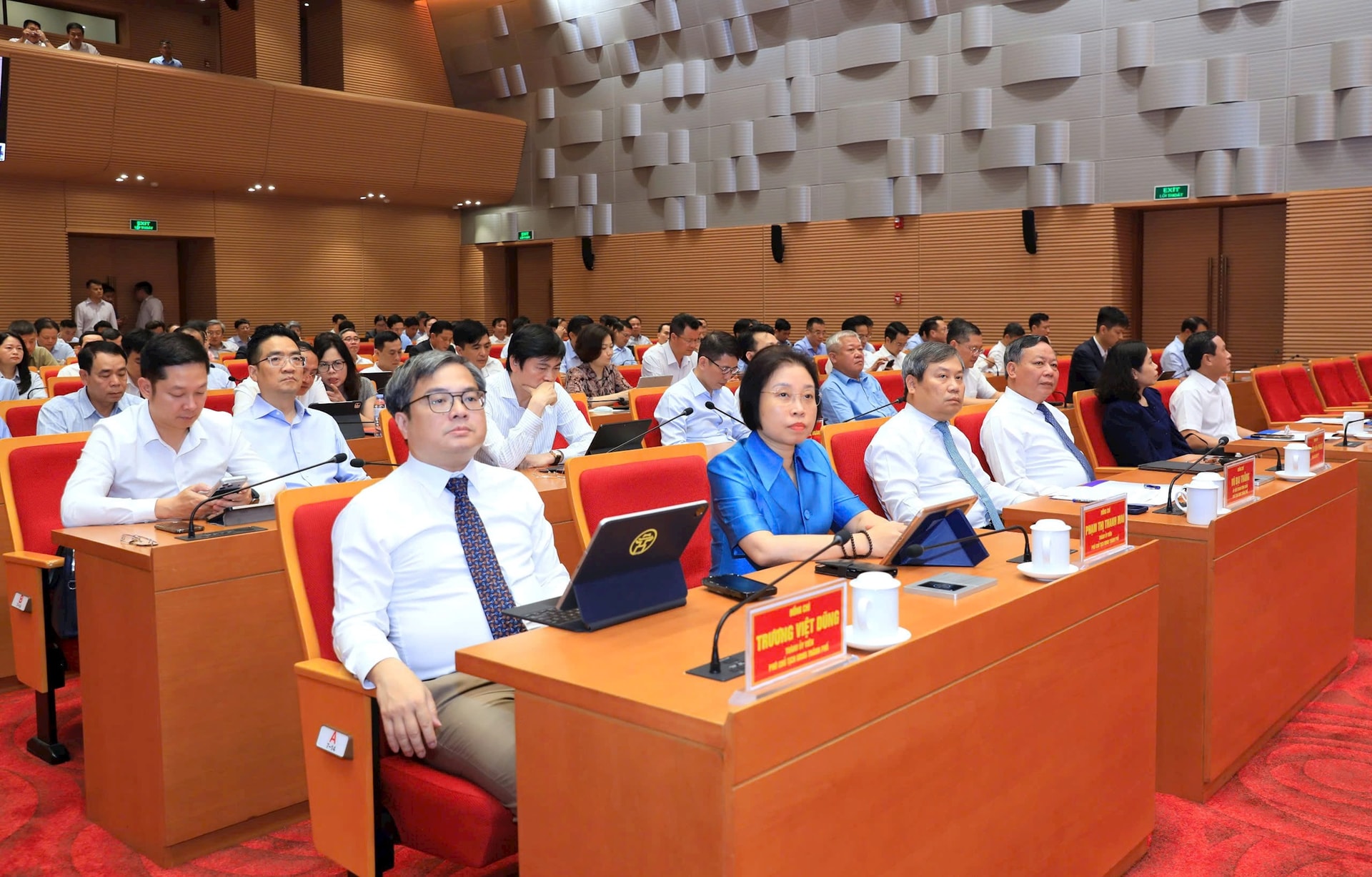
 Delegates attend the conference. Photo: Le Hai
Attending the conference were Vu Dai Thang, Member of the Party Central Committee, Deputy Secretary of the Hanoi Party Committee, and Chairman of the Hanoi People's Committee; Nguyen Van Phong, Deputy Secretary of the Hanoi Party Committee; Pham Thi Thanh Mai, Member of the Hanoi Party Committee and Vice Chairwoman of the Hanoi People's Council; and Truong Viet Dung, Member of the Hanoi Party Committee and Vice Chairman of the Hanoi People's Committee, among others.
The conference was connected online from the Hanoi People's Committee headquarters to departments, sectors, communes, and wards across the city.
Using software to assess administrative reform results in a scientific and rigorous way
Presenting the 2025 Administrative Reform Index results, Nguyen Manh Quan, Deputy Director of the Department of Home Affairs, said the appraisal council had carried out the assessment process in a scientific, rigorous, and methodical manner, using software to evaluate administrative reform performance and ensure the results accurately reflected both shortcomings and achievements across the city.
The Administrative Reform Index includes eight categories. It is based on self-scoring by each unit, appraisal and assessment by the city council, and scores from a sociological survey conducted by the Hanoi Institute for Socio-Economic Development Studies. The maximum total score is 100 points, including 30 points from the sociological survey and 70 points from the appraisal process.
 Nguyen Manh Quan, Deputy Director of the Department of Home Affairs, presents the report at the conference. Photo: Le Hai
In 2025, with the implementation of the two-tier local government model, the city had to adjust the way the Administrative Reform Index was assessed so that it would match the new governance structure.
The city issued a new Administrative Reform Index framework designed to streamline criteria no longer suitable under the previous model. It placed greater emphasis on criteria such as organizational restructuring, the development of internal regulations and processes, and the integration of several reform-related indexes, including the Digital Transformation Index, the index measuring services for citizens and businesses in administrative procedures and public service delivery, and the city's internal SIPAS index.
At the same time, the city continued to update bonus-point content in administrative reform, focusing on initiatives and innovative models, science and technology development, and breakthrough digital transformation efforts with wide-ranging impact, clear results, and replication potential across agencies and units. It also recognized reform tasks that helped improve central government-assessed indexes for Hanoi, such as the PAR INDEX and SIPAS.
Alongside revising and supplementing evaluation criteria, the city also introduced a new method for determining the Administrative Reform Index of agencies and units by using weighted coefficients, group-based comparisons, and A, B, and C rankings. This approach not only improves fairness in scoring and ranking, but also encourages agencies and units to make stronger breakthroughs and improve public service performance. In 2025, the city also fully implemented online distribution, collection, processing, and aggregation of sociological survey forms for the first time.
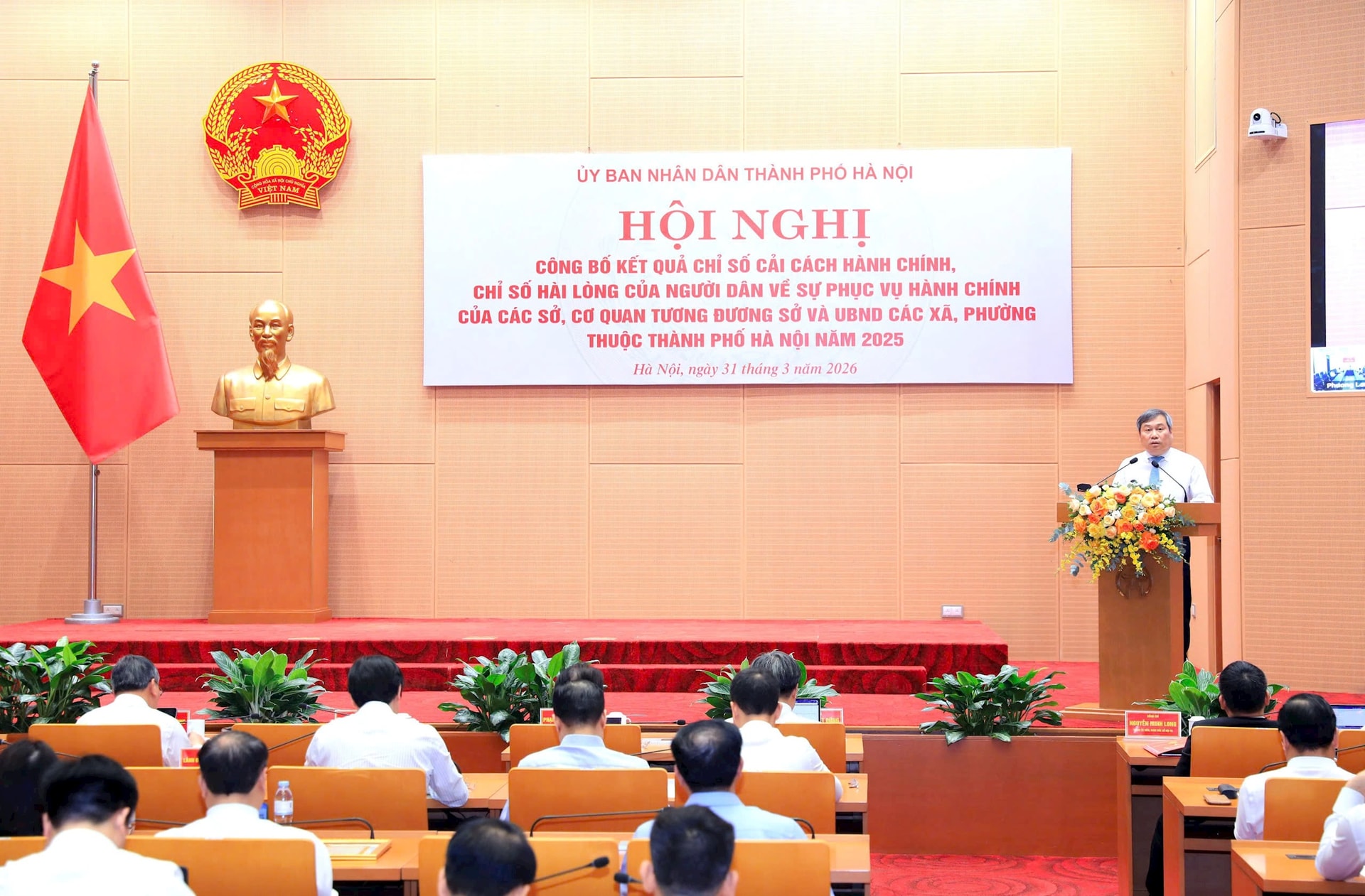 Conference overview. Photo: Pham Linh
Based on the 2025 scoring results, administrative reform and the implementation of Hanoi's political tasks generally achieved many notable outcomes, with positive and visible improvements. The working attitude of officials, civil servants, public employees, and workers in performing public duties improved significantly. Information and communication efforts were stepped up, leading to greater understanding and support from residents and businesses for the efforts of authorities at all levels. Leadership attention to facilities, equipment investment, and personnel arrangements also contributed to improving the effectiveness of the government apparatus and supporting the city's overall socio-economic development.
Many units posted high 2025 Administrative Reform Index scores
For departments and department-level agencies, the average 2025 Administrative Reform Index score was 92.2%, up 5.65 percentage points from 2024. Sociological survey scores for these units were all relatively high and showed little variation, ranging from 27.98 to 28.96 out of 30 points, reflecting positive satisfaction levels among surveyed groups with service quality and operational effectiveness.
The top-ranked departments and department-level agencies in the 2025 Administrative Reform Index were the Department of Home Affairs at 98.05%, followed by the Department of Finance at 97.88%, and the Office of the Hanoi People's Committee at 97.77%.
For communes and wards, the 2025 Administrative Reform Index results were high and relatively even across groups. Of the 126 communes and wards assessed, 89 units achieved Grade A, with scores ranging from 90.06 to 95.58, accounting for 70.63%. Another 37 units received Grade B, with scores ranging from 80.28 to 89.99. No unit was ranked Grade C.
The sociological survey results for communes and wards were mostly between 26 and 28 out of 30 points, with many units scoring above 27 points. The highest score was 28.36 and the lowest was 24.99. These results reflect the level of satisfaction among residents and organizations with the service quality and operational effectiveness of grassroots authorities.
The leading units in the 2025 Administrative Reform Index for Group I wards were O Cho Dua Ward People's Committee at 94.73%, followed by Ngoc Ha Ward People's Committee at 93.89% and Hai Ba Trung Ward People's Committee at 93.80%.
The leading units in Group II wards were Tay Ho Ward People's Committee at 93.94%, followed by Phuc Loi Ward People's Committee at 92.87% and Vinh Tuy Ward People's Committee at 92.76%.
The leading units in Group III wards were Tung Thien Ward People's Committee at 95.58%, followed by Thuong Cat Ward People's Committee at 93.79% and Son Tay Ward People's Committee at 93.43%.
The leading units in Group I communes were O Dien Commune People's Committee at 94.80%, followed by Phu Xuyen Commune People's Committee at 93.88% and Phuc Thinh Commune People's Committee at 93.33%.
The leading units in Group II communes were Phuc Tho Commune People's Committee at 94.34%, followed by Tien Thang Commune People's Committee at 93.12% and Hoa Xa Commune People's Committee at 92.76%.
The leading units in Group III communes were Ung Hoa Commune People's Committee at 94.59%, followed by Van Dinh Commune People's Committee at 94.55% and Chuyen My Commune People's Committee at 93.22%.
According to Nguyen Manh Quan, Deputy Director of the Department of Home Affairs, the scientific and rigorous implementation of the plan, together with the responsibility shown by agencies and units and the growing participation and supervision of the public and society in administrative reform, has made the Administrative Reform Index increasingly substantive, objective, and fair, turning it into an important tool for evaluating reform results. It is also a valuable source of information that helps agencies and units identify their strengths and weaknesses in carrying out reform tasks, so they can adopt more appropriate policies and management solutions in the years ahead.
Nguyen Manh Quan also said that the Satisfaction Index of Public Administrative Services will be sent to all departments, sectors, communes, and wards, and will be published in the media.
Administrative reform must become a growth driver
In his concluding remarks at the conference, Vu Dai Thang, Chairman of the Hanoi People's Committee, affirmed that administrative reform continues to be identified by Hanoi as one of its key and ongoing political tasks.
He said it plays a decisive role in improving the effectiveness and efficiency of state management and the quality of services for residents and businesses, while also directly contributing to the capital's economic growth and socio-economic development.
According to the city chairman, in the current context, administrative reform cannot be carried out in isolation. It must be closely and synchronously linked with science and technology development, innovation, digital transformation, and the building of digital government, the digital economy, and digital society.
He said the city has clearly defined its guiding view: administrative reform is a growth driver; residents and businesses are at the center of service delivery; satisfaction is the measure of effectiveness; and implementation results are an important basis for evaluating officials and civil servants, especially agency heads.
To ensure administrative reform becomes more substantive and effective in the coming period and creates more visible change, Thang asked all levels and sectors to focus on eight key groups of tasks.
First, he said, the city must continue to tighten administrative discipline and order, strengthen the role and responsibility of agency heads, and ensure that every agency and unit acts proactively and decisively in leading and directing administrative reform. At the same time, units must closely link reform results with the evaluation and classification of officials, civil servants, and public employees, as well as with emulation and reward programs, and strictly handle cases of avoidance, shirking responsibility, and causing inconvenience to residents and businesses.
At the same time, units must continue streamlining the organizational apparatus, improving the quality of officials and civil servants, reforming the civil service system based on results, and accelerating digital transformation and digital government development. Every task must have clearly defined outputs, measurable indicators, and a specific deadline.
He particularly emphasized the need to continue strongly renewing methods of leadership and administration in a scientific, transparent, and effective direction, and to strictly follow the principle: "Once Hanoi says it will do something, it will do it fast, do it right, do it effectively, and follow through to the end."
Localities and units were instructed to fully internalize the requirements of "6 dare, 5 ease, 6 clarity," especially the need for clarity in who is responsible, what is to be done, accountability, timeline, results, and authority, and to put an end to vague task assignments without clear responsibility, inspection, or performance evaluation.
Based on the 2025 PAR Index results, Thang asked agencies and units to seriously review, analyze, and comprehensively assess their performance, clearly identify strengths, weaknesses, causes, and specific responsibilities, and then develop plans to improve the 2026 PAR Index and results in the following years with specific, feasible solutions and a clear roadmap, ensuring that evaluation is substantive, objective, and linked to actual outputs.
"All levels and sectors must continue to promote a proactive spirit, innovation, creativity, and more decisive and effective action so that administrative reform truly becomes a development driver, contributing to building an increasingly civilized and modern capital city," Thang said.
On this occasion, the Hanoi People's Committee decided to reward 17 collectives and 17 individuals for outstanding achievements in the 2025 emulation movement on promoting administrative reform across Hanoi.