In line with the Law on Organization of Local Government, on the morning of November 26 the 16th Hanoi People's Council for the 2021–2026 term convened its 28th session to consider important matters within its authority.
Attending the meeting were Politburo member and Standing Vice Chairman of the National Assembly Do Van Chien, Politburo member and Secretary of the Hanoi Party Committee Nguyen Duy Ngoc, and Deputy Secretary of the municipal Party Committee and Chairwoman of the People's Council Phung Thi Hong Ha.
Also present were Deputy Secretary of the municipal Party Committee Nguyen Trong Dong, Deputy Head of the Hanoi National Assembly Delegation Nguyen Ngoc Tuan, and Member of the Standing Board of the City Party Committee and Chairwoman of the Vietnam Fatherland Front Committee of Hanoi Bui Huyen Mai.
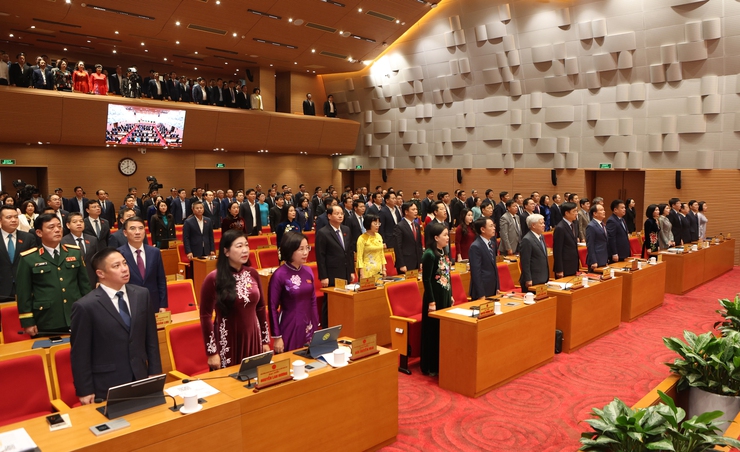
Overview of the meeting.
In her opening remarks, Chairwoman of the People's Council Phung Thi Hong Ha said the 28th session is the regular year-end meeting in 2025 to review socio-economic development, national defense and security, state budget revenue and expenditure, public investment in 2025 and tasks and solutions for 2026.
The session will also review and issue a number of regulations, mechanisms and policies to promptly concretize the 2024 Capital Law and decide on many other important matters.
Under the resolution of the People's Council on the organization of sessions in 2025, the regular year-end meeting was scheduled for early December. However, in a spirit of urgency and proactiveness, and in close alignment with the directions of the central government and the city, the timeline was reconsidered.
Following the instruction of the Secretary of the City Party Committee at the 27th session of the People's Council, who urged "counting down each day to remove difficulties for the grassroots and reclaiming each day and month to complete assigned tasks", the Standing Committee of the People's Council decided to move the session up by about one week.
This adjustment aims to ensure timely consideration and adoption of contents that will serve as a basis for the capital's development in 2026 and for the five year socio-economic development plan for 2026–2030, and to prepare for the next election cycle.
To prepare for this session, the Standing Committee of the People's Council proactively coordinated with the People's Committee and the Vietnam Fatherland Front Committee of Hanoi to carefully prepare documents so that the session can consider, discuss and adopt resolutions that are lawful, easy to understand, easy to implement and suitable to reality.
In a shared spirit of responsibility across the capital's government system, as soon as the People's Committee submitted materials, the Standing Committee of the People's Council directed the Council's committees to conduct verification immediately, even on weekends and in the evening, to avoid any delay, making full use of every day and hour to review documents thoroughly and promptly send them to deputies so they would have more information before voting.
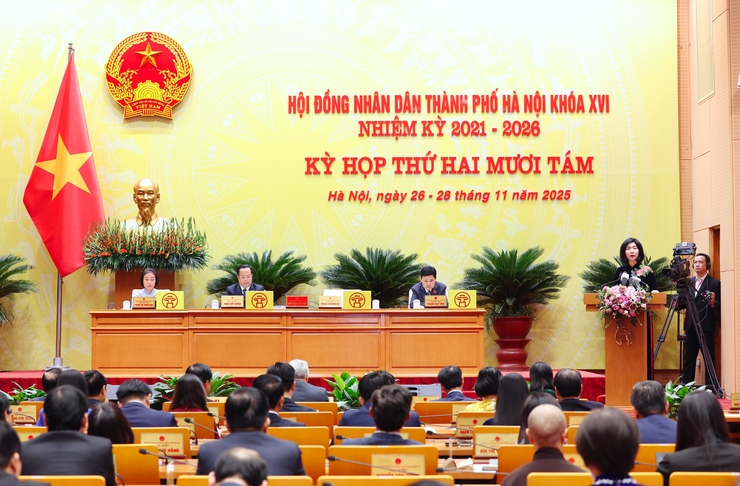
Overview of the meeting.
At this session, in line with the drive to promote the application of technology and digital transformation, all reports of the Standing Committee and the committees of the People's Council are presented in digital form and shown on screen, helping deputies follow and grasp the content more easily.
Under the agenda, the People's Council will examine three groups of issues.
First, the Council will review and assess the implementation of tasks on socio-economic development, national defense and security, state budget revenue and expenditure and public investment in 2025, and the key tasks for 2026.
Despite a global context that remains complex and unpredictable, the city has maintained a positive economic growth trajectory.
The city's GRDP for the whole year is estimated to rise by 8.5 percent year on year, while accumulated state budget revenue by the end of October 2025 reached VND567.9 trillion (US$22.7 billion), up 34.4 percent over the same period, with full year revenue estimated at VND642 trillion (US$25.7 billion), equivalent to 124 percent of the target.
Alongside these results, supervision by the People's Council and its Standing Committee, opinions and recommendations from voters and important instructions of Party General Secretary To Lam at the 18th Congress of the City Party Committee show that the city still faces a number of difficulties, challenges and limitations that must be addressed.
These include flooding, traffic congestion, food safety, air pollution and pollution of rivers and lakes.
In particular, the city must accelerate direction and administration to strive to complete the 2025 socio-economic targets, especially the GRDP growth target of over 8.5 percent, thereby laying the foundation for growth of 11 percent or higher from 2026 onward and for the entire 2026–2030 period.
Second, the People's Council will consider and approve 21 reports and 49 resolutions.
The resolutions stem from the implementation of new documents of the central government and also respond to the practical needs of Hanoi, covering issues such as levels of support and payments for social welfare, regulations on social assistance standards and beneficiaries of specific social assistance policies, and policies for agricultural and rural development in the city.
They also include approval of the iHanoi digital citizen platform as a unified digital platform to serve people and businesses and to support urban administration, projects and works for socio-economic development and contents related to funding to support grassroots security.
These contents have been directed consistently by the City Party Committee, People's Council, People's Committee and Vietnam Fatherland Front Committee of the City in the spirit of issuing new mechanisms and policies in a timely manner to best serve social welfare and public well-being.
They aim to remove bottlenecks and constraints in policy and legal regulations and to encourage officials and civil servants to increase labor productivity and improve the effectiveness and quality of their work.
Contents with wide impact and involving many groups of beneficiaries have been widely consulted with voters and subjected to feedback from the City Fatherland Front Committee.
These feedbacks serve as an important source of information for deputies of the People's Council when discussing and making decisions.
Third, regarding questioning activities, based on legal regulations and actual conditions, the Standing Committee of the People's Council collected deputies' opinions in writing and received high consensus on conducting questioning in written form.
With this method, the right of deputies to question is still exercised fully in accordance with the law and suits the city's circumstances.
Right after agreeing on this form of questioning, the People's Council sent forms to collect deputies' opinions on matters of concern and groups of issues that require questioning.
Before the opening of the session, deputies had sent back their questions and the Standing Committee consolidated them into 34 questions to be sent to the People's Committee, departments, agencies and district and commune People's Committees.
The questions and the responses will be sent to relevant bodies and made public in the media and on the website of the National Assembly Delegation and the People's Council of the City so that all levels, sectors and voters can follow and supervise.
Together with the rest of the country, the city's immediate task is to align with major orientations such as the five year socio-economic development plan for 2026–2030, the indicative framework for the five year medium term public investment plan for 2026–2030 and the five year financial and budget plan for 2026–2030 of Hanoi.
The city must also promptly and effectively implement strategic resolutions of the Politburo on reform, renewal and breakthroughs in national development.
Hanoi is entering a new stage of rapid development, which first of all requires building and completing institutions and proposing amendments to Resolution 15 of the Politburo on directions and tasks for the development of the capital, in connection with amendments to the Capital Law and the two major master plans of the city.
The city will base itself on seven new resolutions of the central government to design breakthrough mechanisms and policies that create pillars and drivers with a new mindset and higher or unprecedented targets, aiming to build Hanoi into an increasingly cultured, civilized, modern and happy capital.
Chairwoman Phung Thi Hong Ha called on deputies of the People's Council to fully exercise their functions, tasks and powers as prescribed by law, and to uphold a high sense of responsibility, democracy and wisdom.
She asked them to study and discuss the reports and documents in depth, offer many thoughtful and high-quality opinions, and objectively and comprehensively assess the results achieved while frankly pointing out limitations, shortcomings and their causes.
She also requested that deputies propose and recommend feasible and effective solutions to remove bottlenecks and obstacles and create breakthroughs in socio-economic development, so that the voice of voters is reflected and accompanies the city's political system in its determination to translate the 18th Congress Resolution of the municipal Party Committee and the Politburo's directions into reality in the spirit set out by the Secretary of the Hanoi Party Committee that "Hanoi overcomes all challenges, there is no task that cannot be done and no problem that cannot be resolved."