At the Standing Session of the Central Steering Committee for the Implementation of Politburo Resolution No. 57-NQ/TW on the morning of October 15, Chairman of the Hanoi People's Committee Tran Sy Thanh affirmed that Hanoi has proactively and creatively translated the Party's directions into specific local policies, programs, and initiatives to implement the Capital Law and Resolution No. 57-NQ/TW.
The city has identified institutional reform as its key breakthrough, considering it the "breakthrough of breakthroughs."
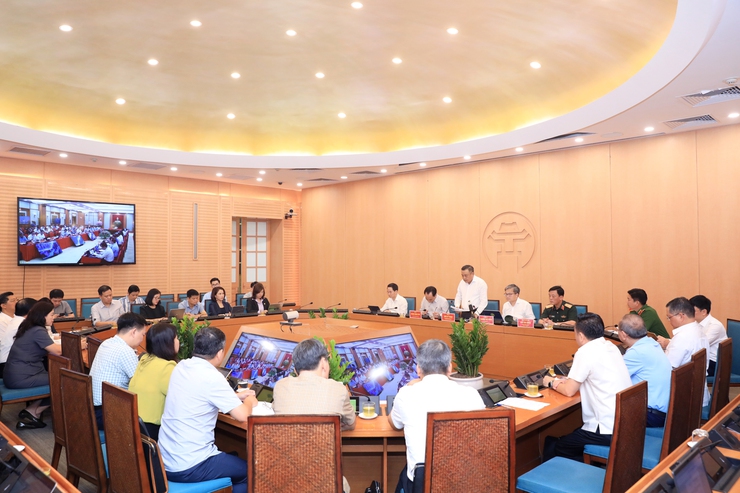
Overview of the meeting.
Chairman Tran Sy Thanh stated that on October 10, 2025, marking both the Liberation Day of the Capital and National Digital Transformation Day, the Hanoi People's Council officially adopted six thematic resolutions on science, technology, innovation, and digital transformation. Together, they form a circular and cohesive development chain with three major breakthroughs.
The first breakthrough is unlocking the legal corridor for innovation and encouraging a mindset of daring to think, act, and take responsibility—embracing controlled risks to advance within the innovation value chain. This includes two resolutions.
The first is the Resolution on Controlled Testing Policies (sandbox). The immediate goal is to pilot at least 15 sandbox models in 2026, with at least one-third transitioning into official operation.
The second is the Resolution on Science and Technology Development Policy, shifting from "administrative management" to a "results-based commissioning" model.
The city has identified 14 key science and technology sectors, including 8 areas defined in the Capital Law and 6 new ones based on Hanoi's needs and realities, such as smart urban management, smart education, smart healthcare, biomedical technology, financial technology, and high-tech agriculture.
Hanoi will cover 100% of procurement and operating costs for scientific research projects and 50% of experimental production costs through project-based funding. Leading organizations will be allowed to select investors independently and flexibly adjust funding allocations.
The second breakthrough is developing a modern technology market that links scientists, businesses, and the government. This includes two resolutions.
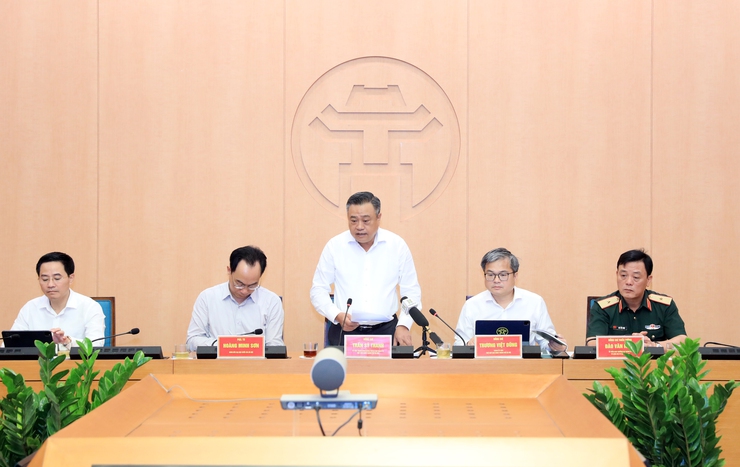
Delegates at the meeting.
The first is the Resolution on the Hanoi Technology Exchange, which will operate as an enterprise under a public-private partnership (PPP) model. The city will provide financial support, waive related fees within its jurisdiction, and offer intellectual property valuation and legal consultation services to encourage scientific commercialization.
The initial target is to list 1,000 technology profiles, facilitate 200 brokerage deals, and commercialize 100 inventions, thereby establishing a practical science and technology market.
The second is the Resolution on establishing the Hanoi Innovation Center (HIC), envisioned as the nucleus coordinating the city's innovation ecosystem.
Structured as a joint-stock company with state control and flexible autonomy, the center will receive 100% state investment in initial science and technology infrastructure, connecting research, testing, incubation, and commercialization.
Strong partnerships are expected with leading domestic and international institutions, including the National University of Singapore, Seoul Startup Hub (South Korea) — which joined during the General Secretary's state visit to South Korea from August 10 to 13 — and domestic entities such as the Ministry of Public Security's C06 Department, the Vietnam Academy of Science and Technology, and Vietnam National University, Hanoi. The goal is to support 500 research groups and startups, with 50 projects reaching the market by 2026.
The third breakthrough is mobilizing financial resources for innovation, which includes two resolutions.
The first is the Resolution on the Hanoi Venture Capital Fund. The city's capital contribution will not exceed VND600 billion (US$23.7 million), accounting for no more than 49% of total charter capital.
The fund will invest through equity, convertible loans, and co-financing, governed by an independent appraisal council, with flexible exit mechanisms such as IPOs and M&A. It will serve as "seed capital" to stimulate private investment in high-tech sectors and creative startups.
The second is the Resolution on Investment and Support Policies for the Innovation Ecosystem, considered the "runway" for startup development.
Specific measures include covering 70% of capacity-building and expert consulting costs during the first three years, fully funding startup selection events for ecosystem operators, and offering interest subsidies for R&D, consulting, and laboratory activities.
"With these six resolutions, Hanoi has allocated about VND1,000 billion ($39.5 million) for science and technology development in 2025.
In 2026, the city will increase this amount to approximately VND6,000 billion ($237 million), accounting for more than 7% of total science and technology spending. Hanoi is now launching a 90-day high-intensity campaign to implement these six resolutions across the entire political system," Chairman Tran Sy Thanh stated.