He addressed several points raised during the meeting and explained that the commune level workforce currently comes from three sources: district level officials assigned to communes, former commune officials who continue serving and staff rotated or seconded from city departments.
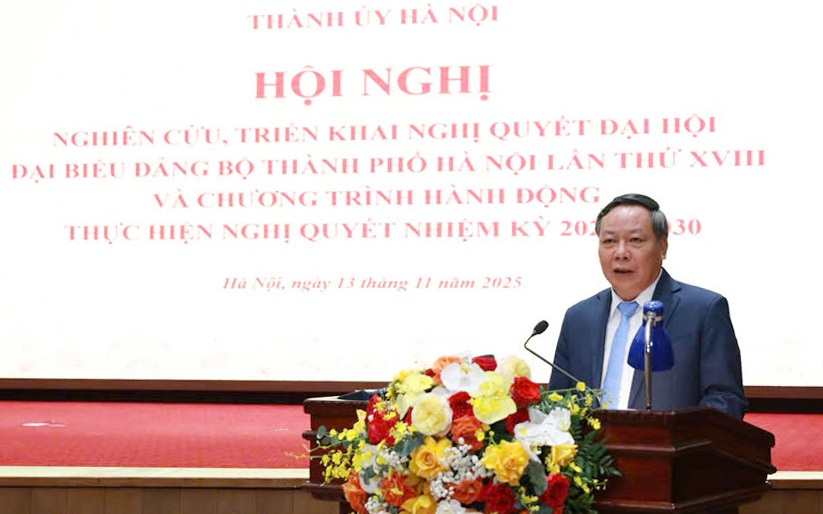
Deputy Secretary of the Hanoi Party Committee Nguyen Van Phong.
He said that while staffing is sufficient in number, qualifications and expertise are uneven and some areas such as information technology and digital transformation still lack highly skilled personnel.
He said the city had tasked the Party Committee's Organization Commission and the Department of Home Affairs with developing a personnel plan for the two tier urban government model with five priority solutions, including completing a personnel database down to each job position, strengthening training through hands on instruction, organizing focused courses by specialty and position, contracting universities to build talent pipelines and establishing mechanisms to rotate and second officials from the city to the grassroots level. He said each official must also take initiative in learning and improving their capacity.
He said the Party Committee recognized long standing shortcomings in urban development such as traffic congestion, flooding, air pollution, land management and construction order.
He said the city was carrying out urgent works to prevent flooding before the 2026 rainy season and was implementing pollution control projects for inner city rivers, with the To Lich River already showing improvement, followed by the Lu, Set and Kim Nguu rivers.
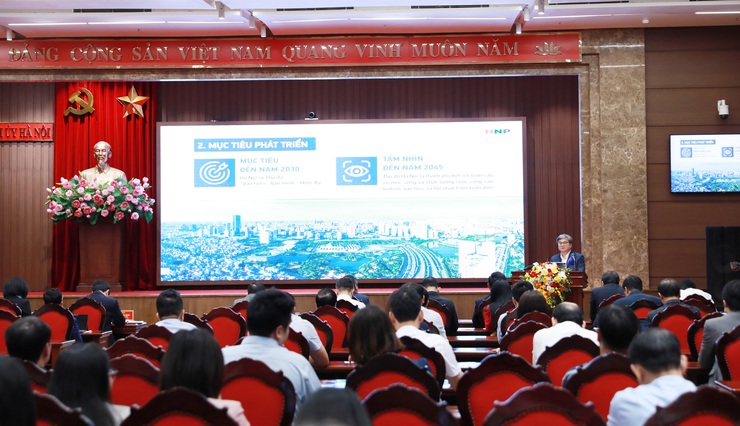
Overview of the meeting.
He said Hanoi had developed an air quality control plan with input from domestic and international experts and that along with management solutions, the city was promoting public awareness to reduce open burning of waste and straw.
He said that immediately after the Congress, the Standing Committee established two important steering committees: one to review and adjust the capital development master plan and one to remove institutional obstacles, mobilize resources and propose pilot mechanisms.
He said working groups would soon meet with localities to review operational problems related to city level policies so the steering committees could resolve them at the highest level.
He said cultural industries had major potential in Hanoi due to its rich cultural assets, a growing middle class, a young population, a large creative community and strong development in science and technology.
He noted that Hanoi was the first locality to adopt a thematic resolution on cultural industries in February 2022 and that the sector had grown quickly and contributed about 4.9 percent of GRDP in 2024, making the target of 8 percent by 2030 achievable.
He said cultural industry development depends on the determination of Party committees and authorities and on public support. He cited Son Tay Town as an example where sustained cultural events had transformed it into a vibrant destination.
He said many delegates were interested in the happiness index. He explained that the international HPI includes criteria such as life expectancy, income, satisfaction with living conditions, community cohesion, government transparency, life balance and personal safety.
He said Hanoi had included HPI in its development indicators to pursue the goal of becoming a happy city and that the city's Institute for Socioeconomic Research was working with international organizations to complete a Hanoi specific HPI, expected for release in the first quarter of 2026. He said pursuing happiness and public satisfaction has no finish line and requires every level of government to treat public satisfaction as the most important measure.
He asked all Party committees to continue studying and thoroughly disseminating the resolution and to develop concrete action programs aligned with the viewpoints, goals and targets set by the eighteenth Congress of the Hanoi Party Organization.