The Vietnam Fatherland Front Committee of Hanoi on October 13 held a social feedback conference on three draft resolutions of the Hanoi People's Council regarding policies and measures to support the implementation of urban renovation and renewal projects in the city.
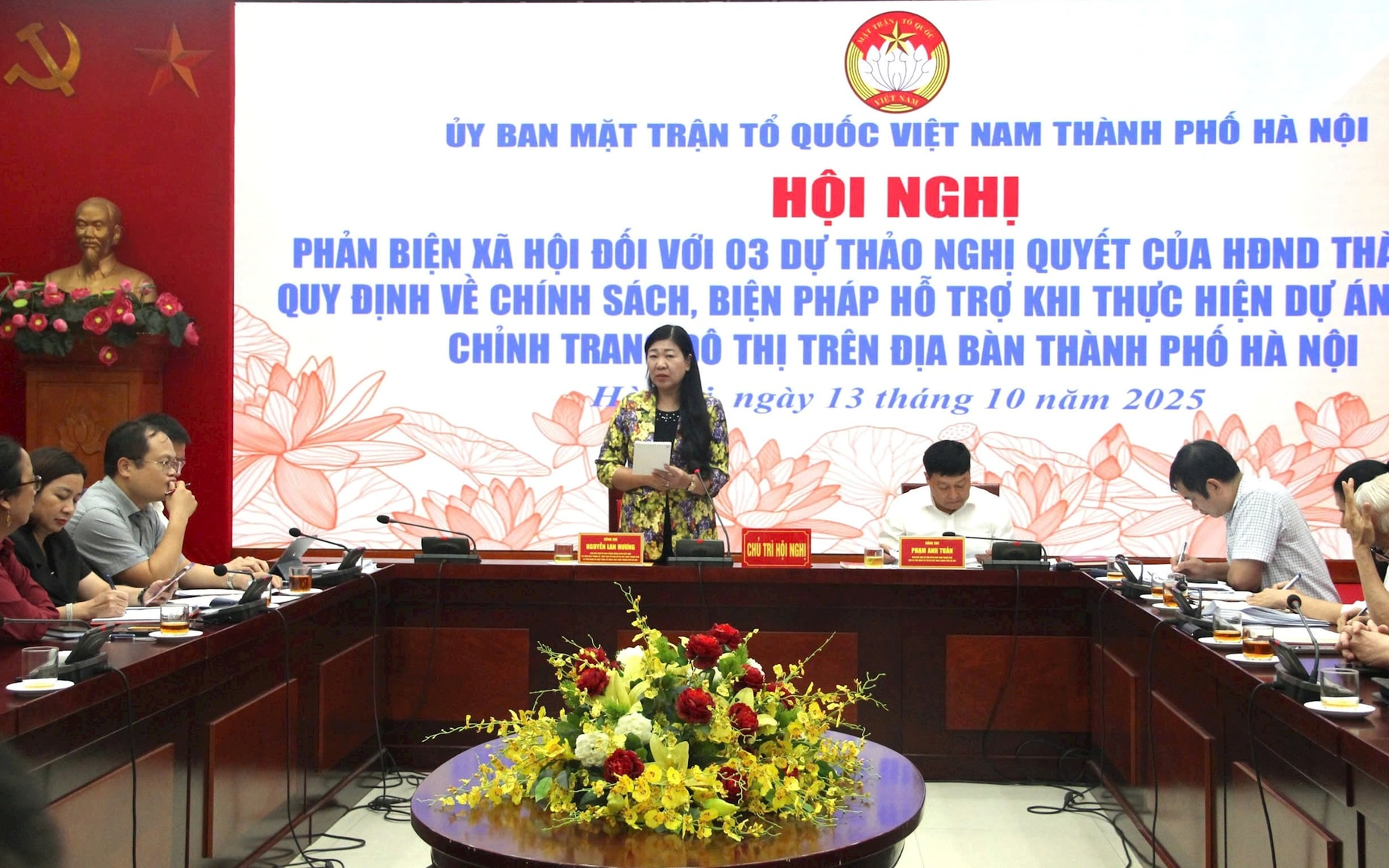
Overview of the event.
The meeting was co-chaired by Nguyen Lan Huong, Standing Member of the Hanoi Party Committee and Chairwoman of the Vietnam Fatherland Front Committee of Hanoi, and Pham Anh Tuan, Vice Chairman of the committee.
The three draft resolutions discussed at the meeting include: (1) regulations on implementing urban renovation and renewal projects in Hanoi; (2) regulations on compensation, support, and resettlement policies for urban renovation, renewal, and old apartment reconstruction projects; and (3) regulations on measures to support and encourage the renovation and preservation of urban areas and architectural heritage sites.
These resolutions aim to concretize Articles 20 and 29 of the 2024 Capital Law, remove obstacles in urban renewal, and introduce policies to accelerate the renovation of degraded urban areas and residential buildings.
During the session, eight delegates presented opinions, most agreeing that the proposed resolutions are necessary and consistent with the Capital Law 2024 and other relevant legislation.
Regarding the draft resolution on compensation, support, and resettlement, some experts noted that although the proposed compensation framework is closer to market prices, it remains significantly lower in practice and requires further adjustment.
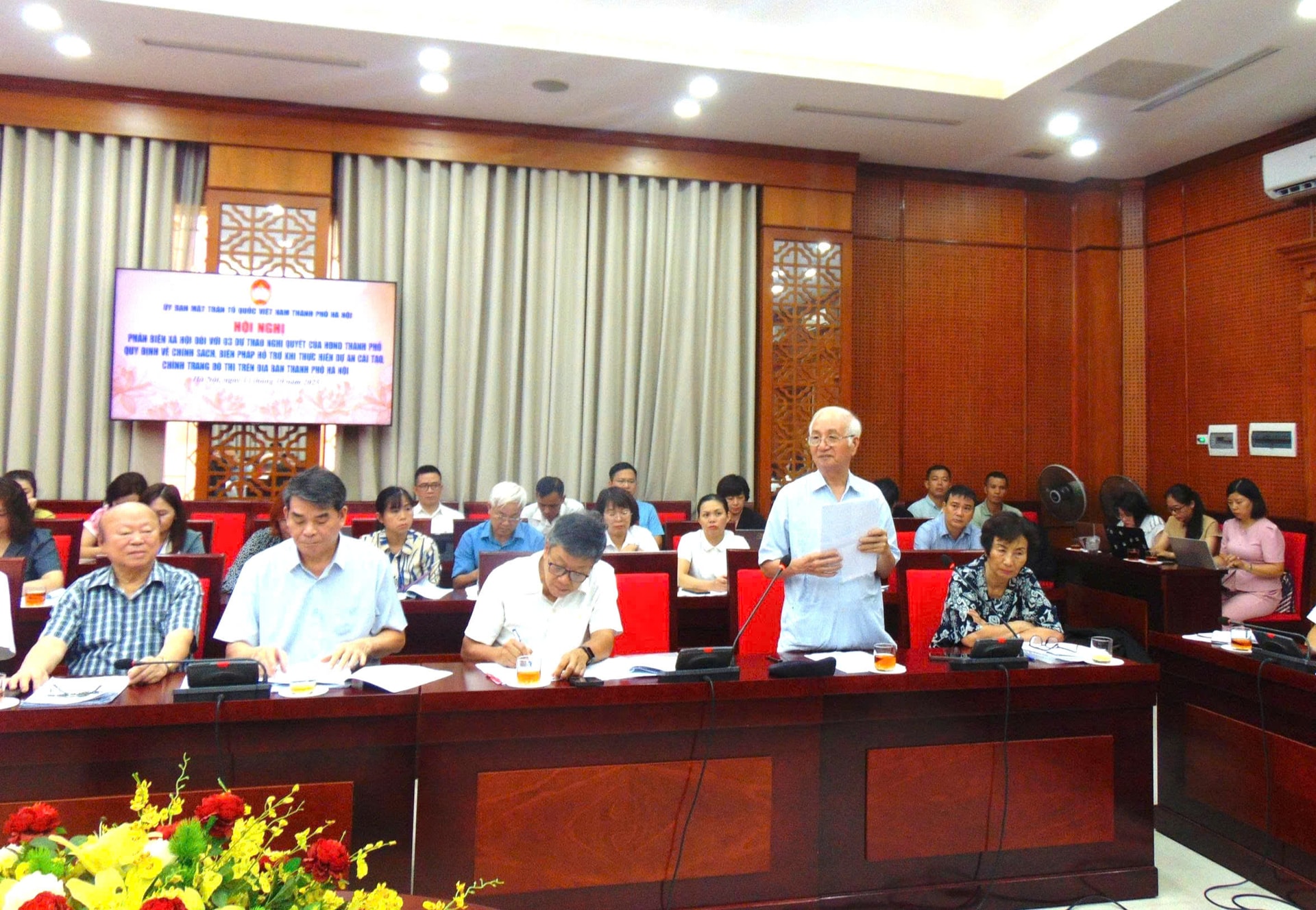
Delegates at the event.
They also emphasized the need for clearer policies to protect the livelihoods of ground-floor business households, suggesting that new projects should allocate commercial spaces for purchase or lease by affected residents.
For the draft resolution on incentives and support mechanisms for renovation projects, several experts argued that the draft lacks a clear linkage between incentives and public benefits or conservation outcomes.
For instance, if a project receives land incentives, it should commit to dedicating a defined portion of space to public amenities or social housing. Additionally, the absence of specific criteria or scoring systems for selecting eligible projects could lead to inconsistency or a lack of transparency in implementation.
Dr. Architect Dao Ngoc Nghiem, Vice Chairman of the Vietnam Urban Planning and Development Association, commented that the three draft resolutions remain somewhat fragmented and should be reorganized to ensure coherence.
He suggested that the urban renovation and renewal resolution should serve as a general framework, while the other two should provide detailed operational mechanisms.
Associate Professor Dr. Bui Thi An, Deputy Head of the Economic Advisory Council under the Hanoi Fatherland Front Committee, also emphasized that while the city has established a clear compensation framework tied to land valuation, compensation levels are still much lower than actual market values, leaving many residents unable to afford new housing in the same area.
She recommended more flexible policies tailored to specific urban contexts, such as heritage zones, the Old Quarter, or architecturally valuable residential blocks.
Concluding the conference, Chairwoman Nguyen Lan Huong stated that the three resolutions are expected to be submitted to the Hanoi People's Council for approval at its December 2025 session.
She proposed that the drafting bodies organize additional consultations with experts and academics to further refine and improve the resolutions, ensuring they meet practical needs.
She stressed that the Vietnam Fatherland Front Committee agrees on the urgency of adopting these resolutions to address citizens' concerns and balance the interests of the State, investors, and residents while enhancing the effectiveness of local governance.
Regarding investor incentives and Hanoi's special mechanisms, she highlighted the need for rigorous implementation procedures to prevent arbitrary or exploitative use of preferential policies.
Huong also noted that future implementation should clarify delegation and authorization mechanisms, assign clear responsibilities to local authorities, residents, and businesses, and phase project execution appropriately.
She emphasized the importance of transparency in controlling construction density, population increases, and social infrastructure to prevent errors during the renovation and redevelopment process, ensuring that urban renewal aligns with the city's sustainable and inclusive vision.