The team reviewed preparations for the election of deputies to the 16th National Assembly and the election of People's Councils at all levels for the 2026 to 2031 term, as well as plans for the period before, during and after the Lunar New Year and the 2025 performance review of the Standing Committees of the two commune Party Committees.
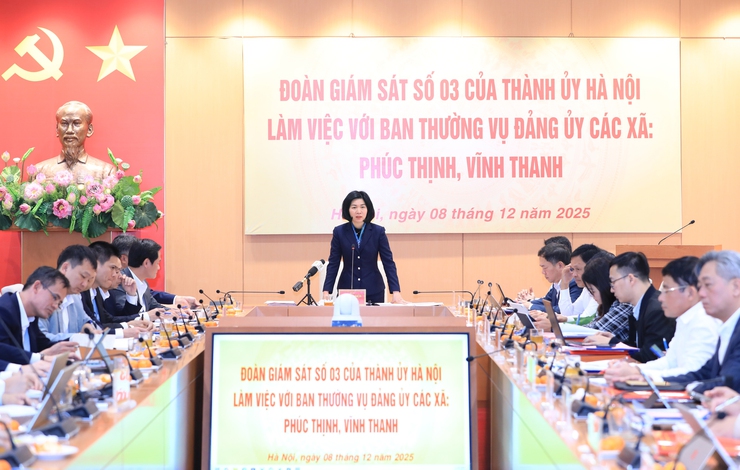
Overview of the meeting.
Reporting to the supervisory team, Deputy Secretary of the Party Committee and Chairman of the Phuc Thinh Commune People's Committee Nguyen Van Bang said the commune has effectively carried out decentralization and authorization in state management and delegated authority for handling 207 administrative procedures.
He noted that the mobile literacy model is an innovative approach. Many projects have been implemented on schedule and completed, though bottlenecks in procedures and site clearance have slowed disbursement progress.
The commune's disbursement rate has reached 37.48 percent of the allocated capital plan, which is lower than the citywide average. Phuc Thinh has completed site clearance for two projects, including the renovation of the Ba Chu village cultural house and the construction of a frontage road and embankment along the Dao Nguyen Khe River from Cau Doi to the Hanoi Lao Cai railway.
The commune has also reviewed and reorganized the use of public land and buildings to ensure efficiency and prevent wasteful or improper use of cultural houses, community venues and health stations.
For Vinh Thanh Commune, Deputy Secretary of the Party Committee and Chairman of the Commune People's Committee Nguyen Quang Dang reported that since the adoption of the two tier administrative model, all incoming and outgoing documents have been processed electronically with digital signatures.
The rate of on time administrative case resolution is 98 percent and citizen satisfaction scores place the commune 13th out of 126 communes and wards in handling administrative procedures. The disbursement rate for public investment capital is 56.06 percent of the allocated plan, which is higher than the citywide average.
Since July 1 2025, the commune has handled a large volume of site clearance equivalent to more than 54 hectares and 1,005 households. Several long-pending projects have been resolved. The management and use of funds for site clearance have met project needs without delays caused by capital shortages. The commune has also carried out a timely and comprehensive review of all public properties including land and buildings.
The leaders of Phuc Thinh and Vinh Thanh communes affirmed that preparations for the election of deputies to the 16th National Assembly and People's Councils for the 2026 to 2031 term, as well as preparations related to the Lunar New Year, are being actively implemented according to guidance from higher authorities and local conditions.
In her concluding remarks, Supervisory Team Leader Phung Thi Hong Ha commended the achievements of Phuc Thinh and Vinh Thanh communes.
She noted that despite the short time frame for implementing the two tier administration model, the leadership teams of both communes have adapted quickly and maintained strong unity among the Party Committee, authorities, the Fatherland Front and local businesses and residents.
She stressed the importance of shifting toward more effective supervisory methods. Although the preparations for Tet and the upcoming elections were not discussed extensively during the meeting, both communes addressed these tasks clearly in their reports, allowing more time to focus on urgent issues that require immediate solutions. She said this reflects a clear, priority-driven working approach.
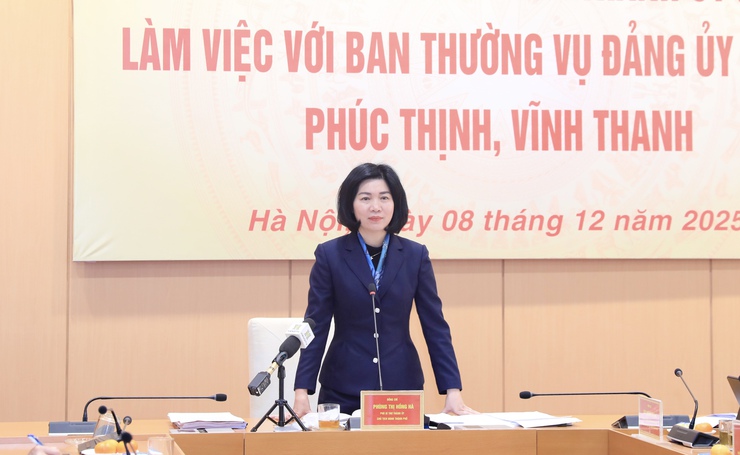
Chairwoman of the Hanoi People's Council Phung Thi Hong Ha.
For the period ahead, Vice Secretary Phung Thi Hong Ha asked both communes to give the highest priority to site clearance. She requested the Party Committees to direct the commune People's Committees and their specialized units to coordinate closely with city departments to ensure that construction begins as soon as clearance is completed, with no delays caused by subjective factors.
She also asked both communes to immediately review the progress and capital needs of each project and prepare plans to adjust capital allocation for submission to the city for consideration so that 100 percent of assigned funds can be disbursed.
The communes must quickly review and complete procedures to discontinue projects that cannot be implemented due to boundary overlaps or changes in land use functions. She urged them to prepare thoroughly for the 2026 to 2030 public investment plan, identify priorities and compile early dossiers that meet urgent community needs.
Regarding site clearance, she stressed the need to strengthen communication and direct dialogue with residents to build consensus, particularly with households facing difficulties.
She asked the communes to identify the exact obstacles and work proactively with city departments to resolve them and report issues related to mechanisms or policies that exceed local authority.
She also emphasized that the Standing Committees of the commune Party Committees are responsible for prioritizing public investment projects and must allocate resources first to essential facilities such as schools and health stations.
On decentralization and authorization, the Chairwoman of the Hanoi People's Council said city agencies must advise the People's Committee based on the principle that authority allocation must go hand in hand with resource allocation. She noted that delegation involves not only transferring responsibility but also ensuring adequate capacity.
She added that many officials at both city and grassroots levels are new in this term and called on commune level officials to strengthen discipline and professionalism and focus on meaningful performance rather than formal achievements.
She urged the leaders of Phuc Thinh and Vinh Thanh to communicate a strong message to all civil servants and public employees that they must work with determination, initiative and responsibility and follow the principle of completing the work rather than merely completing work hours.