Nguyen Manh Quyen, Member of the Standing Committee of the City Party Committee and Vice Chairman of the Hanoi People's Committee, on October 29 worked with Da Phuc Commune on the results of implementing the two-tier local government model and on socio-economic development tasks for the coming period.
Smooth operation of the two-tier local government model
According to the report, after being established from the merger of seven former communes, including Tan Hung, Bac Phu, Xuan Giang, Viet Long, Duc Hoa, Xuan Thu and Kim Lu, Da Phuc Commune covers more than 55 square kilometers and has a population of 81,235 residents. The commune quickly stabilized its organizational structure and operated the two-tier local government model effectively.
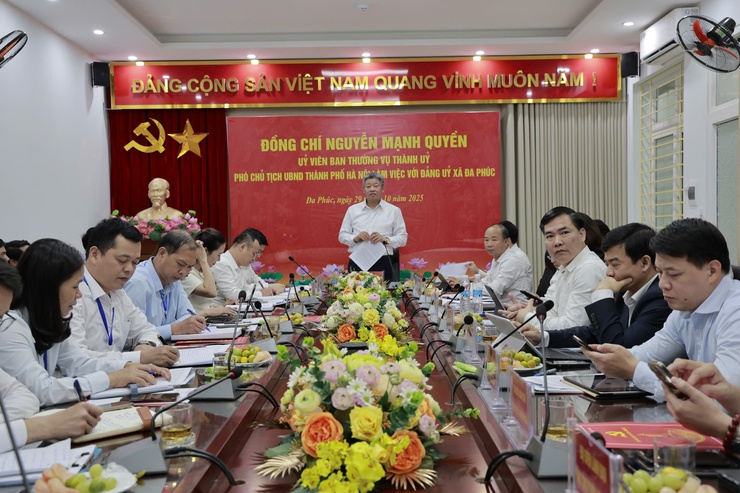
Overview of the meeting.
In the first four months of operation, the Commune Party Committee successfully held its first Party Congress for the 2025–2030 term and consolidated the political system. The Commune People's Council adopted resolutions on socio-economic development for 2025 and its monitoring program for 2026.
Da Phuc maintains about 3,080 hectares of agricultural production, including 33 specialized farming areas, 12 VietGAP-certified zones and 200 hectares of organic farming. Average production value reaches VND178–190 million (US$7,400–US$7,900) per hectare, up 6.2 percent year-on-year, and average income in the agricultural sector reaches VND57 million ($2,380) per person per year.
The commune now has 19 OCOP products rated three stars or higher, including several associated with agricultural tourism and digital transformation such as lotus tea, herbal tea and Nep cai hoa vang sticky rice. More than 1,000 craft production facilities, nearly 2,400 business households and 287 enterprises operate locally, creating jobs for more than 4,000 workers.
Infrastructure continues to improve, with all inter-village roads paved, safe electricity access for 99.7 percent of households and clean water for 70 percent. Investments have been made in transportation, irrigation, schools and cultural facilities, and 17 of 21 schools meet national standards.
The commune was heavily affected by Typhoon Matmo (Storm No. 11) but acted proactively, mobilizing more than 18,000 personnel and hundreds of rescue vehicles to protect local residents. Damage of nearly VND100 billion (US$4.17 million) was quickly addressed, with post-storm recovery, environmental sanitation, disinfection and livelihood support carried out promptly.
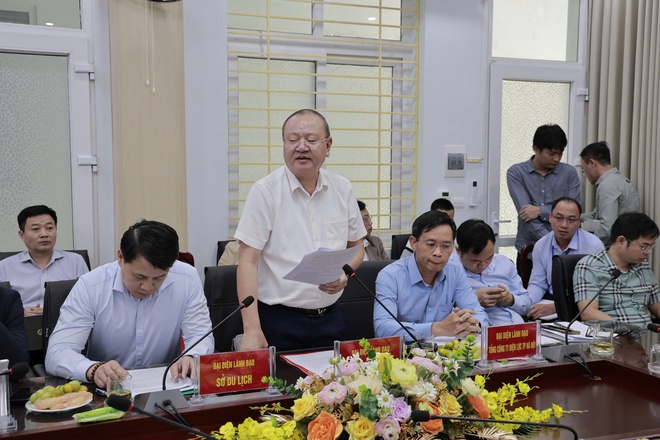
Delegates at the event.
Despite these results, Da Phuc currently meets only 14 of 19 criteria for new-style rural communes under the 2021–2025 standard set, with four criteria partially met and one unmet. Under the draft standards for 2026–2030, the commune meets six of ten criteria and falls short on four. Many achieved criteria remain at low levels and lack sustainability, especially economic infrastructure such as transportation, water supply and drainage, lighting, green space and irrigation.
Da Phuc asked the city to support six areas related to agriculture, new-style rural construction, natural disaster prevention, irrigation and dike management, relocation of households in disaster-prone areas, and development of trade, services, tourism, industry, craft production and infrastructure planning.
Towards a modern new-style rural commune
Concluding the meeting, Vice Chairman Nguyen Manh Quyen praised the commune's comprehensive results, especially the successful implementation of the two-tier government model and its effective response to Typhoon Matmo.
He asked Da Phuc to focus on rapid and sustainable economic development based on ecological agriculture, riverside service and tourism, and comprehensive digital transformation. The goal is to become a modern new-style rural commune by 2030.
Da Phuc must coordinate with departments to improve planning and planning management and prioritize investment in transport infrastructure, especially roads connecting to neighboring areas. The commune must complete disaster-prevention measures, upgrade the right-bank Cau River dyke and left-bank Ca Lo River dyke, and improve pumping stations and drainage canals to protect farmland and residential areas.
He also requested faster crop restructuring towards high-value products, attracting enterprises to invest in production, processing and consumption of agricultural goods, and building smart agricultural value chains linked with tourism. He asked the commune to plan one or two regional-scale commercial service complexes and resolve issues at Xuan Thu industrial cluster to form a clean production zone and boost revenue growth.
Vice Chairman Quyen affirmed that the city will continue supporting Da Phuc in transport, irrigation and disaster-prevention projects and create favorable conditions to attract investment in ecological agriculture and riverside tourism. He said Da Phuc will turn potential into momentum and challenges into breakthroughs, contributing to the development of a civilized, modern and prosperous capital starting from its rural foundations.