Member of the Party Central Committee and Chairman of the National Assembly's Committee for Economic and Financial Affairs Phan Van Mai led the delegation. Member of the Party Central Committee, Deputy Secretary of the Hanoi Party Committee, and Chairman of the Hanoi People's Committee Tran Sy Thanh received and worked with the delegation. Leaders of relevant departments and units attended the meeting.
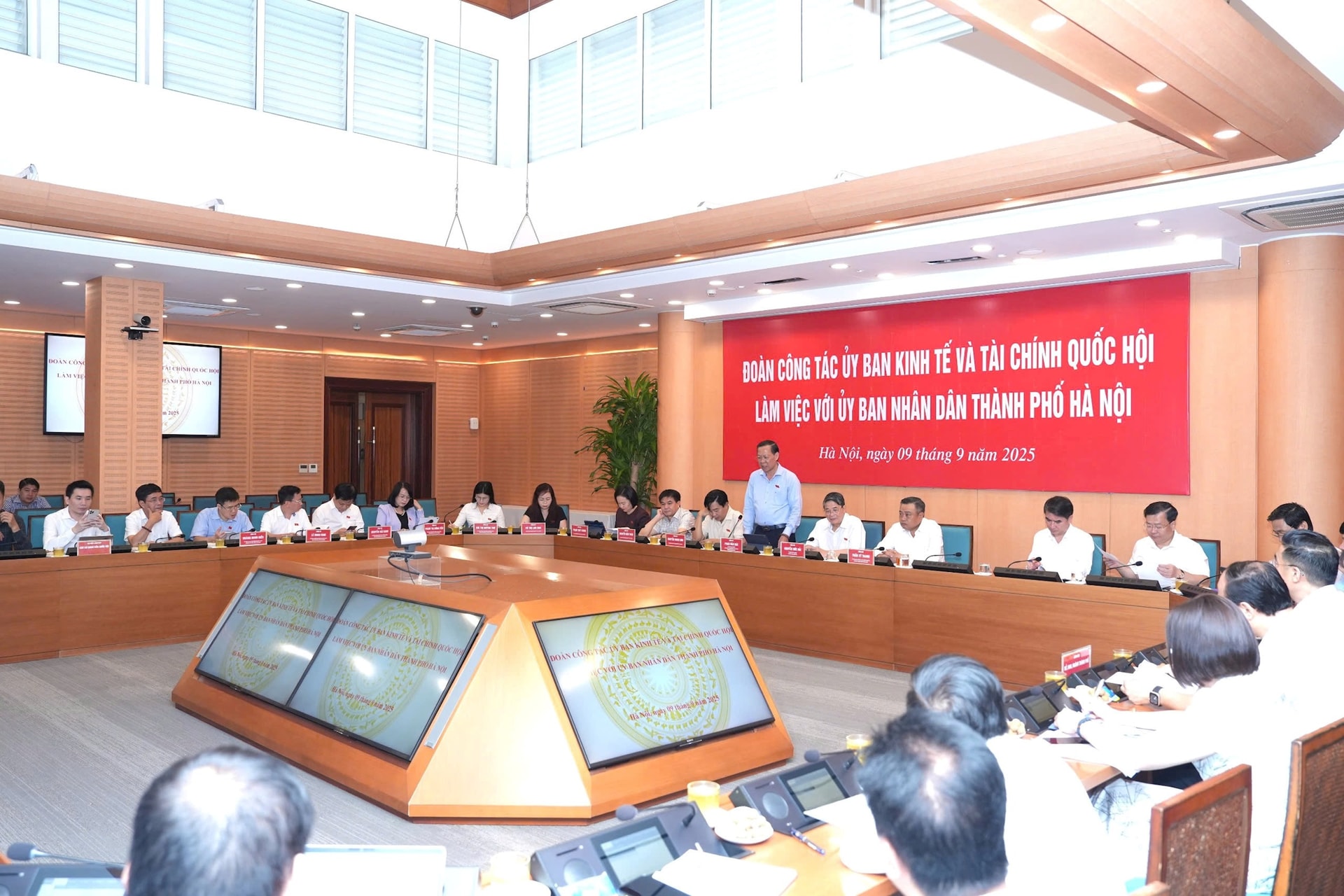
Overview of the meeting.
At the meeting, Director of the Hanoi Department of Finance Nguyen Xuan Luu presented a summary report on the implementation of the 2025 plan for socio-economic development, public finance and budget, and public investment, as well as the results for 2021–2025 and projections for 2026 and 2026–2030.
The report stated that the City People's Council has issued two resolutions and the City People's Committee has issued three action programs and two directives with the target of economic growth above eight percent in 2025, and a striving target above 8.5 percent under Government Resolution No. 226/NQ-CP dated August 5, 2025.
Hanoi's GRDP grew by 7.63 percent in the first six months of 2025, which exceeded the same period in 2024 at 6.13 percent and surpassed the projected scenario at 7.59 percent. The city aims to reach at least eight percent growth for the full year.
Total state budget revenue in the city reached 460,236 billion VND (US$18.2 billion) by August 20, 2025, which achieved 89.6 percent of the annual estimate and rose 34.8 percent year on year.
During 2021–2025, the capital's economy grew at an average of 6.57 percent per year, which was 1.1 times the national rate.
By 2025, Hanoi's economic scale is expected to reach about US$63 billion, which is 1.42 times that of 2020, accounting for 41.54 percent of the Red River Delta and 12.6 percent of the nation, with per capita GRDP estimated at 175 million VND (US$7,200).
For the 2021–2025 medium-term public investment plan, the city has allocated 357,658.425 billion VND (US$14.1 billion) to date.
The unallocated amount under the two-tier local government model is 3,582.958 billion VND (US$141 million). The city is considering allocating 2,886.214 billion VND (US$114 million) from the unallocated pool to important and urgent projects.
Director Nguyen Xuan Luu said that Hanoi will prepare three growth scenarios for 2026, with the preferred option targeting GRDP growth from 10 to 10.5 percent.
For 2026–2030, the city will strive for an average annual GRDP growth rate of at least 11 percent and per capita GRDP above US$12,000.
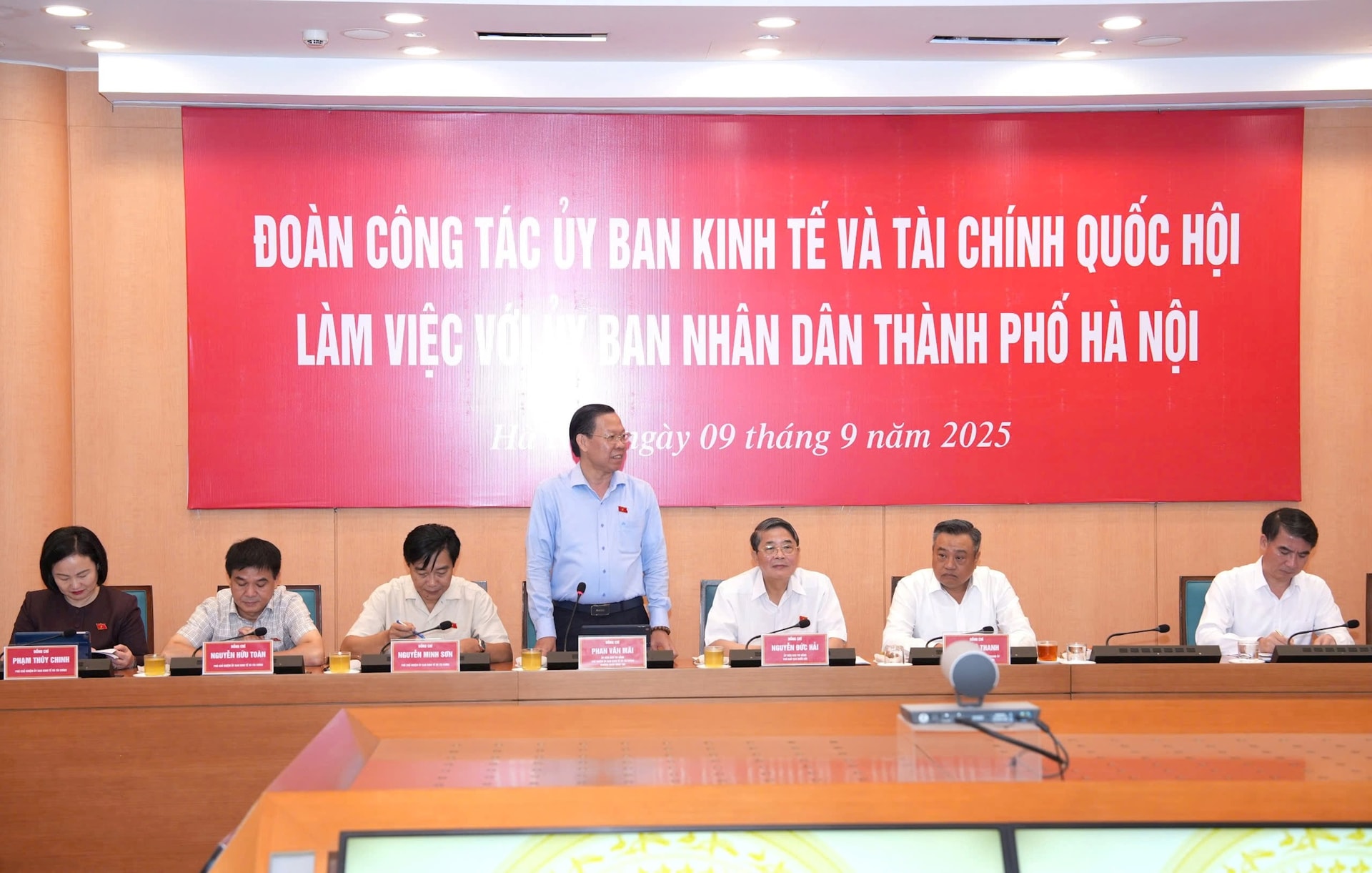
Delegates at the meeting.
Regarding the implementation of National Assembly Resolution No. 56/2022/QH15 on the Ring Road 4 project of the Capital Region, all seven component projects have been approved by Hanoi, Hung Yen, and Bac Ninh.
The projects have approved post-FEED designs and selected contractors, and contractors for the parallel roads are constructing along the entire route.
Hanoi proposed that the Government support the development of detailed growth scenarios for 2026, especially the target scenario of 10 to 10.5 percent GRDP growth with concrete solutions to ensure major balances in budget, investment, exports, and imports.
The city also requested official development assistance and technical support to complete wastewater treatment projects such as Nam An Khanh and Yen Xa, and to restore the environment of four inner-city rivers To Lich, Kim Nguu, Lu, and Set.
The city asked central ministries to help expand export markets, diversify supply chains, and deepen participation in regional and global value chains, with a focus on creative industries, financial technology, and smart logistics.
The city proposed that the Ministry of Agriculture and the Ministry of Natural Resources and Environment support a plan to address localized flooding for 2026–2030 and to implement low-emission zones.
Hanoi emphasized that the need for recurrent expenditure in 2026 is very large due to its status as the national capital.
The city requested that the Ministry of Finance, the Government, and the National Assembly set appropriate revenue and expenditure estimates and a balanced structure between development investment and recurrent spending when drafting the 2026 budget, so that the city can secure resources to meet socio-economic development tasks.
For Ring Road 4, site clearance has reached nearly 99 percent across the project. The remaining sections are mainly residential land, which is the most difficult part and must be completed as soon as possible to keep the overall schedule. The project also faces difficulties with construction materials, which affect progress and costs.
Hanoi therefore requested that the Directorate for Roads of Vietnam report to the National Assembly Standing Committee and propose allowing the contractor of Component Project 3 to continue without mineral mining permits for common construction materials that are listed in the project's material survey dossier, as provided in Resolution No. 56/2022/QH15, until construction is complete.
Members of the delegation and leaders of Hanoi departments discussed achievements and challenges in implementing Central resolutions on socio-economic development for 2025 and beyond.
The discussion highlighted the need to relocate polluting facilities, complete site clearance for Ring Road 4, and accelerate public investment disbursement.
Delegates proposed solutions on mobilizing resources, transforming the economy to meet growth targets, improving the two-tier local government apparatus, and adapting to complex global economic and political fluctuations.
Chairman Phan Van Mai requested that Hanoi further refine the report with deeper analysis of causes and solutions for effective implementation of the two-tier local government model. He also requested solutions for efficient state budget management to prevent loss and waste in breakthrough areas such as education and in the current decentralization and delegation framework.
Mai requested that the city continue contributing to amendments of laws related to planning and land for discussion at the October session of the National Assembly.
He requested that relevant bodies issue implementing documents for the amended Capital Law, and he affirmed that the Committee for Economic and Financial Affairs will accompany Hanoi to resolve difficulties and advise the National Assembly Standing Committee on matters within its authority.
Chairman of the Hanoi People's Committee Tran Sy Thanh welcomed all feedback from the delegation. He stressed that institutional reform and improvements in the investment and business environment are more important for the city than ever.
He said that the city will continue to decentralize and delegate power to communes and wards under the two-tier local government model to speed up major projects and push public investment disbursement.
Chairman Thanh acknowledged existing obstacles in site clearance that slow key projects and affirmed that the city government is making maximum efforts. He noted that the city recently broke ground on Component Project 3, the public-private partnership expressway under Ring Road 4 of the Capital Region.
He said that this is the first public-private partnership transport project of its kind in the country and that preparation took only eight months, whereas projects in Group A used to take no less than ten years to prepare.
He said that this demonstrates the determination of the entire political system to meet set goals, especially in 2026 when the city will launch many large projects.
Vice Chairman of the National Assembly Nguyen Duc Hai delivered guidance at the meeting. He said that Hanoi, as the thousand-year capital and the national political and administrative center, as well as a major hub for culture, education, science, technology, economy, and international exchange, plays a core role in the Capital Region and the Red River Delta.
He recalled that Politburo Resolution No. 15-NQ/TU sets the goal of building and developing Hanoi into a city of Heritage, Civilization, and Modernity. He said that the city aims by 2030 to become a regional leader that drives national development and aspires to reach the level of capitals in developed countries in the region.
He praised the city's results in socio-economic performance, budget revenue and expenditure, and debt management. He commended the city's efforts in implementing Central and Government resolutions to operate the two-tier local government model and in hosting the A80 activities that left a strong impression domestically and internationally.
He requested that the Committee for Economic and Financial Affairs and the meeting's delegates record the city's proposals and, within their authority, study and advise the National Assembly Standing Committee to raise these proposals with competent bodies.
He emphasized proposals to the Government and ministries to achieve growth targets, the 2026 state budget estimate, and the structure of development and recurrent expenditures, given the large recurrent needs of Hanoi.
He requested that Hanoi meet key tasks to complete the 2025 plan and lay a solid foundation for 2026 and for 2026–2030.
He said that the city must lead and direct efforts to achieve targets that are lagging and strive to complete the mandate with the highest possible results, which will create momentum for future terms.
He said that the city must define a clear vision and affirm its central political and administrative role and its core position in the Capital Region and the Red River Delta.
He requested that the city act as a growth engine in the Hanoi–Hai Phong–Quang Ninh triangle and strengthen links with the northern midlands and mountains and the key northern economic region.
He emphasized that Ring Road 4 is a national key project with special significance for completing infrastructure, easing congestion in the inner city, opening new development space, and driving regional linkages and socio-economic growth.
He said that the project is not only a road but a strategic development corridor for Hanoi and the Capital Region for decades to come.
He requested that Hanoi and relevant localities and ministries concentrate on ensuring progress and quality as politically committed, with no delays and no cost overruns. He requested faster site clearance, good resettlement, and protection of legitimate rights of residents to build social consensus.
He requested diverse and efficient resource mobilization, especially public-private partnerships, and integration of the road with urban planning and new economic spaces to form modern urban areas and service-commerce-industry centers with a green, smart, and sustainable orientation.
He said that Hanoi will reorganize its administrative system without expanding boundaries or merging with other provinces and cities, while shifting to a two-tier local government model that ends the district level.
He requested that the city ensure human, material, and financial conditions to implement this model effectively, together with a modern digital-based administration, digital government, and smart city.
He requested that the city align with four Central resolutions and three National Assembly resolutions and tailor them to the city's specific conditions and advantages.
He requested that the city advance the knowledge economy, integrated infrastructure, science and technology, and innovation, and link innovation with the city's unique strengths in national governance, education and training, scientific research, financial services, commerce, tourism, and culture.
He said that these will be the key drivers for Hanoi to break through and affirm its position as a leading national center of knowledge, culture, and high-quality services with regional reach.
He said that the national target of GDP growth of about 8.3 to 8.5 percent for 2025 and double-digit growth in subsequent years expresses the nation's aspiration. He said that this goal is very challenging amid global instability and fierce trade competition.
He said that achieving this growth requires great efforts from all localities. He said that Hanoi, as the national political and administrative center with a leading role in regional and national growth, must adopt breakthrough, decisive, and effective solutions that meet higher requirements than other localities.